
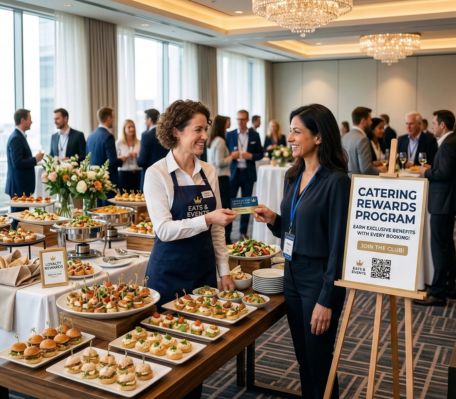
Most restaurants treat catering like a bonus revenue stream. Take the order, deliver the food, hope they call again.
That hope is doing a lot of heavy lifting.
The truth is, catering customers are among the most valuable customers a restaurant can have. A single corporate lunch order can match an entire Saturday dinner rush in revenue. And the office manager who placed that order? She will place it somewhere again next week.
The question is whether it comes back to you.
That is what the top catering loyalty programs are designed to solve. Not just rewarding past orders. Building a reason to come back for the next one.
This guide breaks down how leading restaurant brands have structured their catering loyalty programs, what makes each approach work, and what any restaurant can take from these examples to grow repeat catering revenue.
What Is a Catering Loyalty Program?
A catering loyalty program is a structured system that rewards customers for placing large or recurring catering orders. Unlike traditional restaurant loyalty programs designed for individual diners, catering loyalty programs are built around group orders, corporate clients, office meal programs, and event organizers.
The mechanics vary. Some programs use points. Others offer future order credits, menu upgrades, or exclusive perks. What they share is a common goal: turning a one-time catering customer into a recurring one.
The core logic is simple. Catering customers already spend more per transaction than individual diners. If you can increase their visit frequency even slightly, the revenue impact is significant. A corporate office that orders catering twice a month instead of once represents a doubling of revenue from that single relationship.
Why Standard Loyalty Programs Fail for Catering
Before looking at what works, it helps to understand why most loyalty programs are not built for catering in the first place.
Standard loyalty programs are designed around the individual consumer. Buy a coffee every morning and earn a free one on Friday. That model works because the person spending the money also personally enjoys the reward.
Catering breaks that model immediately.
The person placing a catering order for 30 people is usually an office manager, executive assistant, or event coordinator. They do not eat all the food. They do not personally benefit from earning a free sandwich. They need reliability, they need convenience, and they need to look good in front of the people they are feeding.
Traditional punch cards and generic point systems completely miss this reality. The top catering loyalty programs succeed because they are built for the actual decision-maker, not the theoretical consumer.
Top Catering Loyalty Programs Restaurants Can Learn From
1. Panera Bread: Future-Order Incentives
Panera Bread is one of the few large restaurant chains that has built a loyalty system specifically connected to catering behavior. While their MyPanera program covers individual purchases, their catering rewards structure focuses on large orders placed for offices and group gatherings.
Customers accumulate loyalty credits based on catering order value. As order size and frequency increase, customers unlock perks like future order credits, free menu items, and upgrades.
What makes this work is the direction of the incentive. Rewards are tied to future catering purchases rather than past ones. A corporate office that regularly orders lunch for team meetings might receive a credit that is only redeemable on their next catering order. This creates a pull effect. The reward itself becomes a reason to order again.
The other strength of the Panera approach is simplicity. There are no complex tiers to decode or point calculations to track. Rewards accumulate naturally as ordering continues.
The lesson: Tie rewards to future orders, not past ones. When the incentive points forward, it becomes a growth driver rather than a cost.
2. Subway: Rewarding the Decision-Maker Directly
Subway has long been a go-to for office catering, particularly for sandwich platters and group meal packages. Some locations ran loyalty initiatives specifically aimed at the office managers and event coordinators who placed these orders.
The key insight behind these programs was identifying who actually controls repeat business. When a company needs catering for a training session, the CEO does not call in the order. The office manager does. And that office manager has four or five restaurants they rotate between.
By creating rewards specifically for the person responsible for placing catering orders, including complimentary dessert trays after a certain number of orders and upgraded platters for consistent clients, Subway built loyalty with the actual decision-maker rather than the end consumer.
This distinction matters enormously. The person eating the food is not the same person choosing the restaurant. Loyalty programs that fail to recognize this distinction are investing in the wrong relationship.
The lesson: Identify who controls the catering decision and build your loyalty program around them. That is the relationship worth investing in.
3. Shake Shack Corporate Rewards: Scaling With Order Size
Shake Shack has built corporate ordering initiatives that reward large catering packages and group meal orders. Corporate customers placing bulk orders for events or company gatherings earn loyalty points, exclusive menu perks, or priority access to catering services.
One strength of the Shake Shack approach is the integration with their existing loyalty platform. Corporate clients earn rewards whether they are ordering individually or placing a large catering order. This removes friction. Customers do not have to choose between programs or track separate accounts.
More importantly, the reward structure is designed to encourage larger orders rather than more frequent small ones. When customers reach certain spending thresholds, they unlock bonus rewards or exclusive catering perks. This aligns the incentive structure with the restaurant's business goal: growing revenue per relationship.
The lesson: Structure rewards to grow order size, not just order frequency. Aligning incentives with revenue goals turns loyalty into a revenue strategy, not just a retention tool.
What the Best Catering Loyalty Programs Have in Common
Looking across these examples, several patterns show up consistently.
They reward future behavior, not past behavior. The most effective programs create incentives that pull customers toward the next order. A reward redeemable only on a future catering purchase is far more powerful than a thank-you for a completed one.
They recognize the actual decision-maker. Corporate catering is almost always controlled by a small number of people inside an organization: office managers, executive assistants, event coordinators, and procurement teams. The best loyalty programs are built around these individuals, not the broader team consuming the food.
They prioritize experience over price. Discounts attract customers once. Upgrades, priority access, and exclusivity build habits. When a catering customer feels genuinely recognized and rewarded with a better experience, they are not comparing prices with competitors. They are comparing experiences.
They keep the mechanics simple. Complex point systems create confusion and drop-off. The programs that retain the most catering customers make it easy to understand what to do next and what the reward will be.
They treat the customer as a relationship, not a transaction. This sounds basic, but it is rare in practice. Catering customers who feel like ongoing partners rather than one-time buyers behave very differently. They refer colleagues, forgive occasional mistakes, and resist switching even when a competitor offers a lower price.
How to Apply This to Your Restaurant
You do not need to be Panera or Shake Shack to build an effective catering loyalty program.
Start by identifying your best catering customers. If you have POS data, look for customers who have placed more than one catering order. These are your naturally loyal customers. They already like you. The goal is to make sure they keep choosing you.
Then think about what actually motivates the person placing the order. If they are an office manager, reliability matters more than price. A loyalty program that guarantees priority booking or a dedicated catering contact may be worth more to them than a 10 percent discount.
Consider tiering your program around order size or frequency. Customers who hit certain thresholds unlock better rewards. This does two things at once: it retains existing customers and it incentivizes them to order more to reach the next level.
Finally, make the reward feel personal. A generic email with a coupon code does not feel like recognition. A phone call from your catering manager saying they have flagged a credit on the account feels different. The cost is the same. The impact is not.
Catering Loyalty Is Not a Feature. It Is a Strategy.
The top catering loyalty programs work because they are built around a simple truth: catering customers are not typical restaurant customers.
They are professionals making decisions on behalf of organizations. They care about reliability, efficiency, and being recognized as valuable clients. When a loyalty program speaks to those needs, it becomes part of their decision-making process. When it does not, it gets ignored.
Panera focuses on future orders. Sweetgreen builds workplace routines. Zoe's Kitchen used upgrades instead of discounts. Subway rewarded the decision-maker directly. Shake Shack scaled incentives with order size.
Each of these programs reflects a clear understanding of who the catering customer actually is and what they actually want.
That understanding is the foundation of every successful catering loyalty strategy. Build from there and the mechanics will follow.
Frequently Asked Questions
What makes a catering loyalty program different from a regular loyalty program?
Standard loyalty programs reward individual purchases. Catering loyalty programs are designed for large group orders, corporate clients, and recurring office catering behavior. The decision-maker and the end consumer are often different people, which changes how incentives need to be structured.
What types of rewards work best for catering customers?
The most effective rewards for catering customers include future order credits, complimentary add-ons or menu upgrades, priority booking access, and dedicated account support. Price discounts can work but tend to attract one-time customers rather than building long-term loyalty.
Do catering loyalty programs require special software?
Not necessarily. Some effective programs are managed through simple CRM tools or even spreadsheets at the early stage. What matters is consistent tracking of catering orders, clear reward thresholds, and reliable follow-through on promised rewards.
How do I identify my best catering customers?
Start with your POS or order management data. Look for customers who have placed more than one catering order in the past 12 months. These are your highest-value prospects for a loyalty program because they have already demonstrated repeat intent.
Can smaller restaurants run effective catering loyalty programs?
Yes. Some of the most effective catering loyalty programs are simple and personal. A local restaurant that calls their top catering customers by name, remembers their preferences, and proactively offers a reward before the customer thinks to ask for one often outperforms larger chains with sophisticated technology but impersonal delivery.

.png)
.svg)


.png)

