
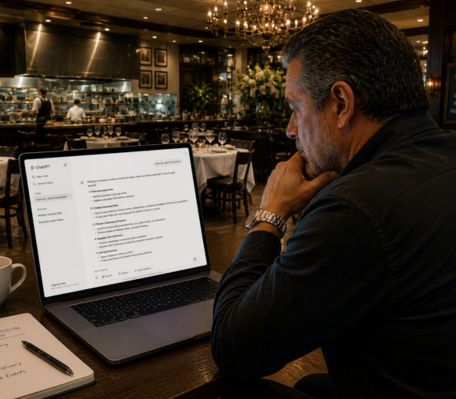
Starting a catering business involves more moving parts than most people anticipate. The food is the visible part. Behind it is market research, business planning, licensing, budgeting, branding, supplier management, marketing, client booking, and financial tracking. Doing all of that without support is the reason many catering businesses stall before they find their first recurring client.
ChatGPT changes the economics of starting a catering business. Tasks that previously required hiring specialists or spending weeks on research can now be done in a fraction of the time. A business plan that would take days to draft takes hours. A marketing strategy that would require a consultant takes a conversation. Menu copy that would take an afternoon takes minutes.
This is not about replacing the expertise required to run a catering operation. It is about removing the writing, research, and planning bottlenecks that slow down every new operator before they ever serve their first order. Here is how to use ChatGPT at each stage of starting a catering business.
How is ChatGPT useful for starting a catering business?
For someone starting a catering business, ChatGPT functions as a generalist assistant that can handle the writing and thinking work across every stage of the launch. It does not run your kitchen, manage your staff, or replace professional legal or financial advice. What it does is produce first drafts, structured frameworks, and researched starting points faster than any human assistant could.
The practical value is significant. A new catering operator without a marketing background can produce a 30-day content calendar. Someone without accounting experience can get a break-even calculation framework. A first-time business owner without a lawyer on retainer can get a preliminary checklist of licensing requirements to verify with the relevant authority. ChatGPT compresses the time between having an idea and having something actionable to work with.
Step 1: Use ChatGPT for market research and business planning
Before investing in equipment, registering a business, or designing a menu, you need to understand the market you are entering. Who is already serving catering in your area. What niches are underserved. What types of events generate the most consistent demand. What price points the market supports. This research shapes every decision that follows.
ChatGPT can compress weeks of market research into a structured starting point in a single session. It will not have real-time data about your specific city, but it can help you build the right research framework, identify the right questions to answer, and draft the analysis once you have gathered the inputs.
Defining your niche: Tell ChatGPT your city, your culinary strengths, your target event type, and any constraints on your operation such as kitchen access or delivery radius. Ask it to outline the pros and cons of targeting each major catering niche: corporate, wedding, social events, drop-off lunch delivery. It will produce a structured comparison that helps you make a more informed choice than starting from instinct alone.
Building a business plan: Ask ChatGPT to generate a structured catering business plan outline covering executive summary, market analysis, service offerings, pricing strategy, marketing plan, operational plan, and financial projections. Use the outline as a template and fill in your specific details. Then ask ChatGPT to help you draft each section based on the information you provide. A business plan that would take days to write from scratch takes a fraction of the time when ChatGPT handles the structure and first draft.
Financial projections: Describe your anticipated startup costs, expected order volume, average order value, and operating expenses. Ask ChatGPT to help you build a simple break-even analysis and first-year revenue projection. It will walk you through the calculation and produce a framework you can adapt as your numbers become more precise. For a first-time business owner, having a structured financial model to present to a bank or investor is one of the highest-value outputs ChatGPT can produce.
Identifying catering trends: Ask ChatGPT what catering trends are shaping corporate and event catering in the current market. It will surface patterns around dietary accommodation demand, sustainable packaging, interactive food stations, and corporate wellness catering that can inform your positioning before you have spent a dollar on marketing.
Step 2: Navigate licensing, permits, and startup budgeting
Compliance with local food safety, health, and business regulations is non-negotiable in catering. Missing a required permit or operating outside of health code can result in fines, forced closure, or liability exposure that ends a business before it builds momentum. Getting this right from the start is worth the time it takes.
ChatGPT cannot replace a lawyer or a local health authority, and you should always verify regulatory requirements with the relevant official body in your jurisdiction. What it can do is give you a comprehensive starting checklist so you know what to verify rather than discovering requirements through trial and error.
Licensing and permit checklist: Ask ChatGPT to generate a checklist of the typical licenses, permits, and certifications required to operate a catering business in the United States, or specify your state or country for more targeted output. The list will typically cover business registration, food handler certifications, commercial kitchen licensing or commissary kitchen requirements, food safety management certifications, liability insurance, and vehicle permits for delivery operations. Use this as your verification list when speaking with your local health department and business licensing office.
Startup budget framework: Describe your planned operation to ChatGPT: whether you are renting a commissary kitchen or using your own, how many staff you expect to need, what equipment you already have versus what you need to purchase, and whether you plan to use a personal vehicle or require a dedicated delivery vehicle. Ask it to generate a categorised startup budget template covering equipment, licensing and permits, insurance, marketing, packaging, initial inventory, and working capital reserve. This framework gives you a structured way to estimate costs before you are deep into planning.
Pricing your services: Ask ChatGPT to help you build a pricing model for your catering packages. Describe your food costs, labor costs, overhead, and desired margin, and ask it to walk you through how to calculate a sustainable per-person price for each service tier. Getting pricing right from the start avoids the common trap of underpricing early clients and then struggling to raise rates once you have established market expectations.
Step 3: Build your brand identity and develop your menu
Your brand is what a potential client thinks of your catering business before they have tasted your food. For a new operation without a track record, the brand has to do more of the trust-building work than it will once you have a portfolio of events behind you. Getting the name, the positioning, and the menu presentation right from the start gives you a foundation to build on.
ChatGPT is particularly useful for the creative and copywriting elements of brand building, which are often the most time-consuming for operators whose strength is in the kitchen rather than in marketing.
Business name brainstorming: Describe your catering niche, your target client, your location, and the tone you want the brand to project: professional, warm, bold, minimal. Ask ChatGPT to generate 20 catering business name options across different naming styles: descriptive names, founder-led names, evocative names, and location-specific names. Use the list as a starting point for evaluating what resonates rather than staring at a blank page trying to generate ideas from scratch.
Tagline and positioning statement: Once you have a name, ask ChatGPT to draft five tagline options and a one-paragraph positioning statement that describes who you serve, what you offer, and what makes you different. This positioning statement becomes the foundation for your website copy, your social media bio, and your sales outreach messaging.
Menu development: Describe your cuisine focus, your target event type, your dietary accommodation requirements, and any constraints on your kitchen or sourcing. Ask ChatGPT to help you structure a catering menu with clear package tiers, logical protein and side combinations, and clean dietary labelling. For corporate catering specifically, ask it to suggest menu formats that work well for office delivery: items that travel well, portion cleanly, and accommodate dietary diversity without requiring individual customisation on every order.
Menu descriptions: Paste your dish names and key ingredients into ChatGPT and ask it to write catering menu descriptions that make the food sound worth ordering. The difference between "Grilled chicken with vegetables" and a description that communicates quality and flavour is the difference between a menu that converts and one that reads like a spreadsheet. ChatGPT produces these descriptions in seconds and typically requires minimal editing.
Step 4: Manage supplier research and vendor communications
Your supplier relationships directly affect your food quality, your cost structure, and your ability to deliver consistently. Finding the right suppliers, negotiating reasonable terms, and maintaining clear communication with vendors is operational work that takes time away from the kitchen.
ChatGPT can handle the writing and research components of supplier management, which frees up your time for the relationship and evaluation work that requires your direct judgment.
Supplier research framework: Ask ChatGPT to generate a list of the key supplier categories a catering business needs to source from: produce, proteins, dry goods, packaging, disposables, and specialty items. For each category, ask it to outline the key questions to ask a potential supplier about pricing, minimum order quantities, delivery frequency, and quality guarantees. This gives you a structured evaluation framework before you make your first vendor calls.
Vendor outreach emails: Ask ChatGPT to draft a professional outreach email to a food supplier introducing your catering business, describing your expected volume and ordering frequency, and requesting a meeting to discuss terms. A well-written first contact letter signals professionalism and often results in better initial terms than a casual phone inquiry.
Negotiation preparation: Before a significant supplier negotiation, describe the situation to ChatGPT: what you currently pay, what you want to achieve, what leverage you have such as volume commitment or prompt payment, and what you are willing to concede. Ask it to help you prepare a negotiation framework and anticipate the supplier's likely responses. Walking into a negotiation with a structured approach consistently produces better outcomes than improvising in the moment.
Step 5: Build your online presence and marketing strategy
A catering business without a visible online presence does not exist to the buyers who are searching for a vendor. Your website, your Google Business Profile, and your social media presence are the first things a potential corporate client or event planner will evaluate before making contact. Getting these right before you actively seek clients is the foundation of a marketing strategy that compounds over time.
ChatGPT can produce the majority of the content and copy your online presence requires, from website copy to social media content to email campaigns, at a speed and cost that would be impossible to replicate with a hired content team.
Website copy: Ask ChatGPT to write homepage copy, a catering services page, an about page, and a contact page for your catering website. Give it your business name, your niche, your target client, your location, and your key differentiators. The output will be a complete set of website copy that you can paste directly into your site builder and edit for tone. This alone saves several hours of writing work and produces copy that is more structured and conversion-focused than most first-time business owners produce on their own.
30-day marketing plan: Ask ChatGPT to generate a 30-day marketing plan for a new catering business launching in a specific city and targeting a specific client type. It will produce a week-by-week plan covering Google Business Profile setup, social media content publishing, local outreach to potential corporate clients, review generation strategy, and initial paid advertising recommendations. Use this plan as a structured launch checklist rather than improvising your marketing activities in the first month.
Social media content calendar: Describe your catering niche, your target audience, and the platforms you plan to use. Ask ChatGPT to generate a month of social media post ideas with suggested captions for each. It will produce a mix of educational content, food photography prompts, behind-the-scenes ideas, client testimonial formats, and promotional posts that give you a varied content calendar without having to generate every idea from scratch.
Email outreach sequences: Ask ChatGPT to write a five-email outreach sequence targeting office managers at local companies, introducing your corporate catering service. The sequence should move from a low-pressure introduction to social proof to a first-order offer over three weeks. These sequences, loaded into an email platform, run automatically and consistently in the background while you focus on the kitchen.
Step 6: Streamline bookings, client communication, and financial tracking
As inquiries start arriving, the administrative work of managing client communication, confirming bookings, sending proposals, and tracking invoices can quickly consume the time you need for food preparation and event execution. Building simple systems for this work from the start prevents the disorganisation that causes early-stage catering businesses to lose clients through slow response times and unclear communication.
ChatGPT handles the writing components of client management, which is where most of the time gets spent.
Catering proposal templates: Ask ChatGPT to write a catering proposal template for a corporate client inquiry. The template should cover your catering formats, per-person pricing, dietary accommodation options, delivery and setup logistics, minimum order requirements, and a clear next step. Having a polished proposal template ready means you can respond to every inquiry with a professional document within the hour rather than writing a new proposal from scratch each time.
Booking confirmation and follow-up emails: Ask ChatGPT to draft a booking confirmation email, a 48-hour pre-event reminder, a day-of logistics confirmation, and a post-event follow-up requesting a review. These four emails, templated and ready to personalise, cover the communication arc of every catering engagement and take less than ten minutes to set up once the templates are written.
Break-even and cash flow calculations: Describe your monthly fixed costs, variable costs per order, and average order value to ChatGPT and ask it to walk you through a break-even calculation and a simple monthly cash flow projection. Understanding exactly how many orders per month you need to cover your costs removes the financial uncertainty that makes early-stage business decisions harder than they need to be.
Invoice and payment terms language: Ask ChatGPT to draft professional invoice payment terms for a catering business, covering deposit requirements, balance due dates, cancellation policy, and late payment fees. Clear payment terms set in writing from the first client engagement prevent the awkward conversations and delayed payments that erode cash flow in the early months of any service business.
Step 7: Use client feedback to improve your catering operation
Client feedback is the most direct signal a catering business has about what is working and what needs to change. Most new operators collect feedback informally, if at all, and miss the patterns that would tell them where to focus their improvement efforts.
ChatGPT can help you design better feedback collection and analyse the responses you receive in a structured way.
Post-event feedback surveys: Ask ChatGPT to write a five-question post-event feedback survey for corporate catering clients. The questions should cover food quality, delivery timing, dietary accommodation handling, ease of ordering, and likelihood to reorder. Short surveys with specific questions produce higher response rates and more actionable data than open-ended requests for general feedback.
Analysing review themes: Paste your Google reviews or survey responses into ChatGPT and ask it to identify the most common positive themes and the most common areas for improvement. What would take 30 minutes of manual reading and categorisation takes ChatGPT seconds. The output is a clear summary of what clients consistently praise and what they consistently flag, which tells you exactly where to invest your improvement effort.
Responding to reviews: Ask ChatGPT to write personalised responses to your Google reviews. Paste in the review text, describe your catering business briefly, and ask for a professional response that acknowledges the specific feedback and naturally includes a location and service reference for SEO value. Responding to every review, positive and negative, within 72 hours signals professionalism and improves your local search visibility simultaneously.
ChatGPT is the starting point, not the shortcut
Every output ChatGPT produces is a starting point that requires your judgment, your local knowledge, and your voice before it is ready to use. The business plan needs your actual numbers. The menu descriptions need to reflect your actual food. The outreach emails need to sound like you, not like a template.
What ChatGPT removes is the blank page problem that slows down every stage of starting a catering business. The research framework, the first draft, the structured checklist, the calculated model. These are the inputs that take time to produce from scratch and that ChatGPT can generate in minutes.
Start with the task that is currently blocking your progress. The business plan you have been putting off. The menu copy you cannot quite get right. The outreach sequence you know you need but have not had time to write. Give ChatGPT the context it needs and let it produce the first draft. The catering business you are building does the rest.
Frequently Asked Questions
Can ChatGPT help you start a catering business with no experience?
ChatGPT can significantly reduce the learning curve for a first-time catering business owner by producing business plan frameworks, licensing checklists, pricing models, marketing plans, and client communication templates. It does not replace the culinary skill, operational judgment, or professional advice from lawyers and accountants that a successful catering business requires. It removes the writing and research bottlenecks that slow down the planning and launch process.
How do you use ChatGPT to write a catering business plan?
Ask ChatGPT to generate a structured business plan outline for a catering business covering your niche, target market, service offerings, pricing strategy, marketing approach, operational plan, and financial projections. Use the outline as a template and fill in your specific details. Then ask ChatGPT to draft each section based on the information you provide. The output is a complete first draft that requires editing and personalisation rather than a finished document.
What catering marketing tasks can ChatGPT handle?
ChatGPT can write website copy, social media captions, a 30-day marketing plan, email outreach sequences to corporate clients, Google Business Profile post content, catering proposal templates, and post-event follow-up emails. It can also draft a positioning statement, brainstorm business names, and generate a month of social media content ideas in a single session.
Can ChatGPT help with catering menu development?
Yes. ChatGPT can help structure a catering menu with logical package tiers, appropriate portion formats, and dietary labelling. It can write menu item descriptions that make food sound worth ordering. And it can suggest menu formats specifically designed for corporate drop-off catering where items need to travel well, portion cleanly, and accommodate diverse dietary requirements without individual customisation.
Is ChatGPT reliable for catering licensing and legal information?
ChatGPT can generate a useful preliminary checklist of the licenses, permits, and certifications typically required to operate a catering business. This is a starting point for verification, not a definitive legal guide. Always confirm specific regulatory requirements with your local health department, business licensing office, and a qualified professional. Requirements vary significantly by state, county, and city.
How can ChatGPT help with catering client communication?
ChatGPT can draft catering proposal templates, booking confirmation emails, pre-event reminder messages, day-of logistics confirmations, post-event follow-ups requesting reviews, and invoice payment terms. Having these templates written and ready to personalise means every client interaction is handled professionally and consistently from the first inquiry onward.
How do you use ChatGPT to analyse catering client feedback?
Paste your Google reviews or post-event survey responses into ChatGPT and ask it to identify the most common positive themes and areas for improvement. It will produce a structured summary of what clients consistently praise and what they consistently flag, which tells you where to focus your operational improvement effort without spending 30 minutes manually categorising individual reviews.

.png)
.svg)


.png)

