
Most catering websites are built to inform, not to convert. They describe the food, list the services, and provide a phone number. Then they wait. That passive approach costs catering businesses more bookings than any competitor ever could.
A catering website that generates consistent revenue is not just a digital menu. It is a sales tool. It answers buyer questions before they are asked, builds trust before the first conversation happens, and makes the path from interest to inquiry as short as possible.
The good news is that most catering websites are so generic that the bar for standing out is not particularly high. A site that does four things well, a compelling homepage, a clear value proposition, a conversion-focused structure, and a forward-looking technical setup, will outperform the majority of competitors in almost any local market.
There are 4 things a catering website needs to do to turn visitors into paying clients. Here is how to approach each one.
1. Craft a homepage that earns trust in the first ten seconds
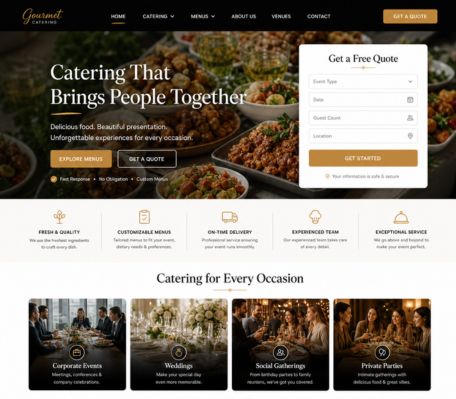
A potential catering client who lands on your homepage makes a judgment about your business within seconds. Not about the food specifically, but about whether this looks like a professional operation worth considering. That judgment happens before they read a single word.
The visual quality of your homepage is doing most of the work in that first impression. Everything else is secondary to getting this right. Three things determine whether a first-time visitor stays or leaves.
Professional photography: High-end catering clients are not buying ingredients. They are buying an experience, a successful event, a smooth operation, a room full of satisfied people. Your homepage photography needs to sell that experience before any copy does. Real event photos, not stock imagery, of your actual food, setups, and events are what build that visual confidence. A single strong hero image of a well-presented catering spread does more selling than a paragraph of descriptive copy.
Clean, intuitive navigation: A cluttered or confusing navigation structure signals a cluttered, confusing operation. Corporate buyers and event planners evaluating vendors move quickly. They need to find your menu, your service areas, your pricing guidance, and your contact information without effort. If any of those require more than one click to locate, you are losing buyers who simply move to the next result. Keep the navigation to five items or fewer and label everything in plain language.
Mobile performance: A significant portion of catering research happens on mobile devices. Office managers checking options between meetings. Event planners comparing vendors on the go. A homepage that loads slowly or renders poorly on a phone loses those visitors before they see a single image. Mobile load speed is also a direct Google ranking signal, which means poor mobile performance hurts both conversion and visibility simultaneously.
2. Lead with a value proposition that speaks to the buyer's actual concern
Every catering buyer arrives at your website with an unspoken question: why should I choose you over the other options I am looking at right now? Most catering websites never answer that question directly. They describe the food, mention the team, and list the occasions they serve. None of that is a value proposition.
A value proposition is a specific, credible statement of what makes your catering service the right choice for this buyer. It lives above the fold on your homepage and every dedicated service page. It is the first thing a visitor reads after the visual impression has been made.
The most effective catering value propositions speak directly to the buyer's dominant concern rather than the caterer's strengths. A corporate buyer's dominant concern is not the quality of the food. It is the reliability of the delivery and the smoothness of the experience. An event planner's concern is whether the vendor can execute at scale without creating coordination work.
What a strong value proposition looks like: "On-time corporate catering for teams of 10 to 500, with full dietary accommodation included on every order." That single sentence answers the corporate buyer's three most pressing questions: can you handle my group size, will you be on time, and can you manage dietary requirements without additional coordination. Compare that to "Delicious food for every occasion," which answers none of those questions and is indistinguishable from every other caterer in the market.
Your value proposition should be specific enough that it would not apply to every other caterer in your city. If it could appear on a competitor's site unchanged, it is not specific enough. The detail is what makes it credible.
3. Build every page around conversion, not information
Traffic without conversion is a website bill, not a marketing asset. Every page on your catering site should be designed around a single question: what action do we want this visitor to take, and how do we make that action as easy as possible?
For most catering businesses, the primary conversion goal is an inquiry: a form submission, a phone call, or a direct booking request. Everything on the page should support that outcome. There are four elements that directly determine whether a visitor converts or leaves.
Calls to action placed throughout the page: Do not make buyers search for how to hire you. A "Request a Quote" or "Book a Tasting" button should be visible without scrolling on every catering service page. Place it above the fold, repeat it at logical decision points as the visitor scrolls, and make it visually distinct from the rest of the page. Buyers who have made a decision will not go looking for a contact form. If it is not immediately visible, they move on.
Short, low-friction inquiry forms: Every additional field in a contact form reduces the submission rate. For a catering inquiry, five fields is the maximum: name, company or organisation, event date, group size, and contact information. Asking for budget, dietary preferences, venue details, and event description at the inquiry stage introduces friction that stops buyers who are still early in their decision. Collect the minimum needed to start a conversation. Get the rest on the call.
Lead magnets for buyers not yet ready to book: Not every visitor who lands on your catering site is ready to make a decision immediately. Corporate buyers planning ahead, event planners in early research, and first-time catering buyers may be weeks away from a booking decision. A downloadable resource, a corporate catering pricing guide, an event planning checklist, or a seasonal menu preview, captures their contact information and keeps your business present while they continue their evaluation. Without a lead magnet, that visitor leaves and likely never returns.
Social proof placed in context: Testimonials and client logos do the most conversion work when they appear alongside the relevant service content, not in a separate reviews section that most visitors never reach. A corporate client testimonial placed on your corporate catering page, next to the inquiry form, reduces buyer hesitation at exactly the moment it matters most. For buyers comparing multiple vendors, a recognisable client name or a specific outcome mentioned in a review, "our 200-person annual conference ran without a single complaint," is more persuasive than any marketing copy you can write.
4. Set up your website for how buyers are actually searching today
Most catering websites are built for how people searched five years ago. Typed keywords, desktop browsers, and deliberate research sessions. That is still part of the picture, but it is no longer the whole picture. The buyers you want to reach are also searching by voice, on mobile, and with increasing expectations of being able to take action directly on your site without an intermediary.
Two technical priorities directly affect your ability to capture this modern catering buyer.
Voice search optimisation: Smart speakers, mobile assistants, and voice-activated Google searches are a growing share of local service queries. "Hey Google, find corporate catering near me." "Who does office lunch delivery in downtown Nashville?" These searches are conversational, specific, and almost always carry immediate purchase intent. Optimising for voice search means structuring your website content around natural question-and-answer language rather than keyword-dense copy. An FAQ section on every service page written in plain conversational language, with direct answers to common buyer questions, significantly increases the chance of your content being selected as a voice search result. Including your service area explicitly in your copy and keeping your Google Business Profile current ensures voice assistants surface your business accurately.
Direct ordering and inquiry capabilities: Third-party catering marketplaces charge 18 to 30% commission on every order. More significantly, they own the client relationship. When a buyer places an order through a marketplace, they are returning to the platform, not to your business, when they reorder. A catering website with a direct ordering or inquiry system embedded, rather than linking out to a marketplace, captures both the immediate transaction and the long-term client relationship. The buyer who books directly with you is a client you can follow up with, enrol in a loyalty program, and convert into a recurring account. The buyer who books through a platform is a transaction that produces margin for the marketplace and almost nothing for you beyond the single order.
Your website is the first order. Make it count.
A catering website that converts is not the result of expensive design or complex technology. It is the result of understanding what buyers need to see before they feel confident enough to reach out, and making sure those things are visible, clear, and easy to act on.
Start with the homepage impression. Add a value proposition that speaks to the buyer's actual concern. Build every service page around a clear conversion path. And set up the technical foundations that capture buyers wherever and however they are searching.
Done well, a catering website does not just represent your business online. It actively works to bring in new clients, qualify them before the first conversation, and make the path from search to booking as short as possible. That is the difference between a digital brochure and a revenue-generating asset.
Frequently Asked Questions
What should a catering website include to attract clients?
A catering website that attracts clients needs professional food photography, a clear value proposition above the fold, dedicated pages for each catering service, visible calls to action throughout, a short inquiry form, and social proof from past clients placed in context. Mobile speed and a direct ordering or inquiry path are equally important for converting visitors who arrive ready to book.
How do you write a value proposition for a catering business?
A strong catering value proposition speaks to the buyer's dominant concern rather than the caterer's general strengths. For corporate buyers, that concern is reliability and dietary accommodation. For event clients, it is execution at scale without coordination problems. State specifically what you do, for what group size, and what the buyer can count on. "On-time corporate catering for teams of 10 to 500, dietary options included on every order" is a value proposition. "Delicious food for every occasion" is not.
How do catering websites convert visitors into bookings?
By removing friction at every step between first impression and inquiry. Visible calls to action throughout the page, a short inquiry form with five fields or fewer, lead magnets for buyers not yet ready to book, and social proof placed next to service content rather than in a separate reviews section all improve conversion rate. The fewer steps between a visitor's arrival and their ability to contact you, the higher the percentage who will.
Should a catering business have separate pages for each service?
Yes. A dedicated page for each catering service, such as corporate catering, wedding catering, and drop-off box lunches, ranks better in search and converts at a higher rate than a single generic page. Each buyer type has different concerns and different search queries. A page written specifically for that buyer, with relevant social proof and a matching value proposition, is significantly more persuasive than a combined page trying to serve everyone at once.
How does voice search affect catering websites?
Voice searches for catering services are conversational, local, and high-intent. Optimising for voice means including natural question-and-answer content on your service pages, explicitly naming your service areas, and keeping your Google Business Profile current. An FAQ section written in plain conversational language on each service page increases the chance of being selected as a voice search result.
Why should catering businesses avoid relying on third-party marketplaces?
Marketplaces charge 18 to 30% commission on every order and own the client relationship. When a buyer reorders through a platform, they return to the marketplace rather than directly to your business. A catering website with a direct inquiry or ordering system captures both the transaction and the long-term client relationship, enabling follow-up, loyalty programs, and repeat bookings that a marketplace would otherwise own.
How important is mobile performance for a catering website?
Critical. A significant portion of catering research happens on mobile devices, and a site that loads slowly or renders poorly on a phone loses those visitors before they see a single image. Google also uses mobile performance as a direct ranking signal, meaning poor mobile experience reduces both conversion rate and search visibility simultaneously.

.png)
.svg)


.png)

