
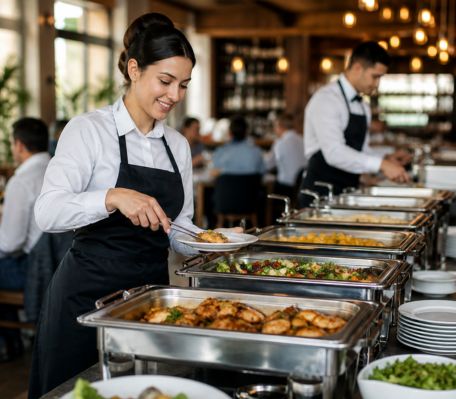
Catering is not a single thing. It is a broad category that includes everything from a box lunch dropped at an office reception desk to a 300-person plated dinner with full staff, bar service, and custom menu. Choosing the wrong type for your event does not just affect the food. It affects the logistics, the experience, the budget, and whether the person organising the event ends the day relaxed or stressed.
Most people searching for a caterer have a specific event in mind but are not always sure which type of catering service matches what they actually need. The result is either over-ordering, paying for full-service staffing for a casual office lunch that did not need it, or under-ordering, choosing drop-off catering for a formal corporate dinner where the presentation and service expectations were not met.
This blogs breaks down every major type of catering, what each one includes, the events it is best suited for, and the factors to consider when deciding which one is right for your specific situation.
What is catering and how is it different from regular food delivery?
Catering is the professional service of preparing, delivering, and in many cases serving food and beverages for events and gatherings. It is distinct from standard food delivery in both scope and intention. A food delivery order fulfils a meal. A catering order is designed around an event, with menu planning, quantity estimation, presentation, dietary accommodation, and often on-site service all built into the offering.
Understanding the different types of catering that exist within this broad category is the starting point for making the right choice for any event.
1. Corporate catering
Corporate catering is designed for business events: office lunches, team meetings, training days, board meetings, client presentations, company conferences, and employee appreciation events. The defining characteristic of corporate catering is that efficiency and professionalism take priority over culinary ambition. The food needs to arrive on time, be easy to serve and eat, accommodate dietary requirements across a diverse group, and require minimal coordination from the person who ordered it.
Corporate catering is one of the highest-volume and most consistent segments of the catering industry. Unlike social events that happen once, corporate catering clients often have recurring needs: weekly team lunches, monthly all-hands meetings, quarterly board dinners. A single corporate catering account can represent significant annual revenue precisely because the demand is predictable and repeating.
Best for: Office lunches, team meetings, client events, company conferences, training days, employee appreciation events, and recurring workplace food programs.
Typical formats: Box lunches, buffet setups, hot bar delivery, breakfast and pastry trays, individually packaged meals, and sandwich and salad platters. Format selection is typically driven by group size, schedule, and whether the event is formal or informal.
What to look for in a corporate caterer: On-time delivery track record, dietary accommodation as a standard offering rather than a special request, transparent per-person pricing, clear lead time requirements, and a simple direct ordering process. For recurring accounts, a caterer that offers loyalty rewards or account credits for repeat orders significantly reduces the friction of managing ongoing catering spend.
2. Wedding catering
Wedding catering is the most emotionally invested category in the industry. It is not just food service. It is a component of one of the most significant events in a couple's life, and every detail from menu selection to plate presentation to the timing of courses relative to speeches and dancing is part of the overall experience being created.
Wedding caterers operate differently from corporate caterers. They work closely with couples over months of planning, coordinating with venue managers, event planners, florists, and photographers to ensure the food service integrates seamlessly with the overall event flow. They manage dietary requirements across guest lists that often include a wide range of preferences, allergies, and cultural considerations.
Best for: Wedding receptions, rehearsal dinners, engagement parties, and anniversary celebrations where the dining experience is a central part of the event.
Typical formats: Plated multi-course dinners, buffet receptions, cocktail hour with passed appetisers, interactive food stations, and dessert tables. Many couples combine formats: a cocktail hour with passed bites followed by a seated plated dinner, for example.
What to look for in a wedding caterer: A portfolio of real events at comparable scale, the ability to offer a tasting before committing, experience coordinating with venues and other vendors, transparent pricing on staffing and equipment, and a clear contract covering menu finalisation timelines, headcount deadlines, and cancellation terms. Book six to twelve months in advance for peak wedding seasons.
3. Social event catering
Social event catering covers the broadest range of occasions: milestone birthdays, graduation parties, family reunions, holiday gatherings, anniversary celebrations, retirement parties, and community events. The defining characteristic is flexibility. Social events vary enormously in formality, size, and budget, and the best social event caterers are able to adapt their service accordingly.
Unlike corporate catering, which prioritises efficiency, or wedding catering, which prioritises experience, social event catering often prioritises atmosphere and personalisation. The food should reflect the personality of the event and the person hosting it. A 70th birthday dinner has different expectations than a casual backyard graduation party for 40 people.
Best for: Birthday celebrations, graduation parties, anniversary dinners, holiday gatherings, retirement parties, family reunions, and community events of any scale.
Typical formats: Buffets, food stations, drop-off platters, cocktail-style passed appetisers, and seated plated dinners depending on the formality and budget of the event.
What to look for in a social event caterer: Menu flexibility, the ability to personalise around a theme or cuisine preference, dietary accommodation, and a pricing structure that scales cleanly with guest count. For smaller social events, drop-off catering often provides the right balance of food quality and cost without the overhead of full staffing.
4. Full-service catering
Full-service catering is a service level rather than an event type. It refers to catering that includes everything: menu planning, food preparation, delivery, on-site setup, professional servers and bartenders, and full cleanup after the event. The host or organiser is not responsible for any aspect of the food service from the moment the caterer arrives to the moment they leave.
Full-service catering is the highest-cost option and the highest-convenience option. It is best suited for events where the host needs to be present as a guest rather than a coordinator, where the formality of the event demands professional service, or where the scale of the event makes self-service impractical.
Best for: Weddings, galas, formal corporate dinners, awards ceremonies, large fundraisers, and any event where professional presentation and seamless guest experience are priorities.
What is included: Menu creation and finalisation, all food preparation on-site or at a professional kitchen, delivery and full setup, professional servers and bartenders, food replenishment throughout the event, and complete post-event cleanup. Equipment such as linens, chafing dishes, serving ware, and glassware is typically included.
What to look for: Staff-to-guest ratios, experience at comparable event scales, the ability to coordinate with other vendors, and a detailed contract that specifies exactly what is and is not included in the service scope. Full-service pricing varies significantly based on menu complexity, staffing requirements, and event duration.
5. Drop-off catering
Drop-off catering is the most practical and most widely used format for everyday corporate catering and casual events. Food is prepared off-site, packaged for transport, delivered to the event location, and set up in a buffet or self-service arrangement. After delivery and basic setup, the catering team leaves. Serving, replenishment, and cleanup are handled by the host or a designated person on-site.
Drop-off catering costs significantly less than full-service catering because you are not paying for on-site staffing. Per-person costs typically range from $10 to $25 depending on menu complexity, group size, and location. It is the dominant format for corporate office catering because it delivers quality food with minimal disruption to the workday and no coordination overhead during the event itself.
Best for: Office lunches, team meetings, casual social gatherings, school and community events, and any event where the host is comfortable handling self-service and does not need on-site staff.
What is included: Prepared food delivered hot or cold, disposable serving trays and utensils, basic setup of the food display, and in some cases labelling for dietary items. Cleanup after the event is not included.
What to look for: Lead time requirements, minimum order sizes, delivery radius, and whether setup is included or just delivery. For corporate accounts placing recurring drop-off orders, a caterer with a direct ordering system and a loyalty program for repeat clients reduces the administrative friction of managing regular catering spend.
6. Buffet catering
Buffet catering is a service format rather than a standalone category. It refers to catering where food is arranged on tables or stations and guests serve themselves rather than being served individually. Buffets can be executed as part of drop-off catering, full-service catering, or anywhere in between depending on whether staff are present to replenish and manage the buffet.
The buffet format works particularly well for large groups with diverse dietary preferences because it allows guests to choose what and how much they eat. It is also more cost-effective than plated service because it requires fewer staff and less precise portion control. Buffets work well for corporate lunches, casual weddings, large birthday events, and community gatherings.
Best for: Large groups with varied dietary preferences, events where guests are mingling rather than seated, casual to semi-formal occasions, and events where cost efficiency is a priority over individual plated service.
Buffet vs. full-service buffet: A drop-off buffet delivers the food and basic setup then leaves. A full-service buffet includes staff who manage the food stations throughout the event, replenish dishes, and clean up at the end. The full-service version costs more but removes all coordination work from the host during the event.
7. Plated dinner catering
Plated dinner catering is the most formal service style. Each guest receives an individually prepared and presented plate, served by professional staff. This format requires significantly more staffing than a buffet because each course must be plated, carried, and served individually to every guest at the appropriate moment.
Plated dinners are used for events where the dining experience itself is a centrepiece of the occasion. Formal corporate dinners, wedding receptions, galas, and fundraising dinners all commonly use plated service because the presentation and pacing communicate a level of care and investment in the guest experience that a buffet cannot replicate.
Best for: Formal corporate dinners, wedding receptions, black-tie galas, fundraising events, and any occasion where the dining experience is intended to impress.
What to consider: Plated service is the most expensive catering format because of the staffing requirements. It also requires more precise headcount confirmation, menu selection from the host or individual guest pre-selection, and tighter coordination between the kitchen and front-of-house team. Lead times for menu finalisation are longer than for buffet or drop-off formats.
8. Food station catering
Food station catering arranges different food offerings at separate stations throughout the event space rather than at a single buffet table. Each station typically features a specific cuisine, protein, or food category: a taco bar, a carving station, a pasta station, a sushi station. Guests move between stations and build their plates according to their preferences.
Food stations create energy and interaction at an event in a way that a single buffet line cannot. They are particularly effective for large corporate events, company parties, and weddings that want a more social and experiential dining format. Interactive stations where food is prepared or assembled in front of guests, such as a build-your-own bowl or a live carving station, create a memorable experience that a passive buffet does not.
Best for: Company parties, large corporate events, wedding receptions with a social atmosphere, milestone celebrations, and events where the food itself is intended to be part of the entertainment.
What to consider: Food stations require more space than a single buffet line. Multiple stations also mean more coordination in terms of staffing each station and managing replenishment across different food types simultaneously. The per-person cost is typically higher than a standard buffet but can be justified by the elevated guest experience.
9. Mobile and concession catering
Mobile catering operates from food trucks, pop-up kitchens, and temporary setups that bring food service directly to the location rather than requiring the event to come to a fixed venue. Concession catering is a related format focused on serving large crowds quickly at sporting events, music festivals, fairs, and public gatherings where high volume and fast service are the primary operational requirements.
The mobile catering market has grown significantly in recent years, driven by the flexibility food trucks offer compared to traditional catering setups. A food truck can serve a corporate campus at lunchtime, a private event in a park on the weekend, and a festival on a holiday weekend. That operational flexibility makes mobile catering attractive for events that would be difficult or expensive to serve through conventional catering logistics.
Best for: Outdoor corporate events, company picnics, street festivals, sporting events, music festivals, campus dining programs, and any event where the novelty and visual presence of a food truck or pop-up station adds to the experience.
Concession catering specifically: Events that prioritise speed and volume over dining experience. A sporting event serving 5,000 people needs a completely different operational model than a 50-person corporate lunch. Concession caterers specialise in the logistics of feeding large crowds efficiently under time pressure, which is a fundamentally different skill set from event or corporate catering.
What to consider: Access and space requirements for the vehicle or setup, power and water availability at the venue, permit requirements for outdoor or public locations, and weather contingency planning. For corporate events using a food truck as a novelty element rather than a primary caterer, confirm the truck's capacity matches your expected attendance so service does not become a bottleneck.
How to choose the right type of catering for your event
Choosing the right catering type comes down to six factors: the formality of the event, the size of the group, the budget, how much coordination you want to handle yourself, your venue requirements, and the time of year.
Formality: A formal corporate dinner or wedding reception warrants full-service or plated catering. A casual team lunch or birthday party is well served by drop-off or buffet. Matching the service level to the event formality avoids both over-spending on unnecessary staffing and under-delivering on events where presentation matters.
Group size: Drop-off and buffet formats scale efficiently to large groups. Plated service becomes increasingly expensive per person at scale because each additional guest requires proportionally more staff time. For events over 100 people where a formal dining experience is expected, the full-service cost per person is worth evaluating early in the planning process. Nearly 80 percent of businesses that order catering regularly serve groups of more than 20 people, which makes format scalability a practical consideration for most corporate accounts.
Budget: Drop-off catering at $10 to $25 per person represents the most cost-effective option for events where self-service is acceptable. Full-service and plated catering costs more because of staffing, but the elimination of on-site coordination work has real value for hosts who need to be present as participants rather than event managers. Factor in what your time is worth when evaluating the cost difference.
How much do you want to manage: If you want to hand the food service over entirely and not think about it again, full-service catering is worth the premium. If you are comfortable managing the setup and serving yourself, or have team members who can handle it, drop-off catering delivers equivalent food quality at a lower cost. For recurring corporate orders, a caterer with a direct ordering platform and a loyalty program that rewards repeat accounts reduces the management overhead further.
Venue requirements: Some venues have specific catering restrictions or exclusive catering arrangements that limit your options before you begin comparing caterers. Always confirm the venue's catering policy before shortlisting vendors. A venue that requires you to use their in-house caterer eliminates the selection process entirely. A venue that restricts outside catering to specific approved vendors narrows it. Checking these requirements early avoids the frustration of finding a caterer you want to use and then discovering the venue will not permit them.
Seasonal considerations: The time of year affects both availability and menu. Peak catering seasons, spring events, summer weddings, and the holiday quarter from October through December, mean the best caterers book up months in advance. Seasonal ingredient availability also affects what is on the menu and at what price. A caterer who builds menus around seasonal produce will offer better value and better quality during peak seasons for specific ingredients than one working from a fixed year-round menu.
The right type of catering makes the event. The wrong one complicates it.
Every type of catering covered in this guide serves a genuine purpose. None of them is categorically better than the others. Full-service catering is not superior to drop-off catering. It is more appropriate for certain events and less appropriate for others. The same applies to every format.
The mistake most event organisers make is choosing based on familiarity rather than fit. Defaulting to a buffet because that is what was done last time. Choosing drop-off for a formal dinner because it is cheaper. Ordering full-service for a casual office lunch because the process felt safer. Matching the catering type to the actual event requirements is what produces the best outcome for guests and the least stress for the person organising it.
Start with the event formality, the group size, and how much of the day you want to spend managing food logistics. Check your venue requirements before shortlisting vendors. And if your event falls during a peak catering season, start the selection process earlier than feels necessary. Let those factors narrow the field, then find the caterer who executes that type consistently and reliably in your area.
Frequently Asked Questions
What are the main types of catering?
The main types of catering are corporate catering, wedding catering, social event catering, full-service catering, drop-off catering, buffet catering, plated dinner catering, food station catering, and mobile and concession catering. Corporate and wedding catering describe the event type. Full-service, drop-off, buffet, plated, food station, and mobile describe the service format. Most catering bookings involve a combination of both dimensions.
What is the difference between full-service and drop-off catering?
Full-service catering includes professional staff who set up, serve, replenish, and clean up throughout the event. Drop-off catering delivers and sets up the food then leaves. The host manages serving and cleanup. Full-service costs more because of staffing but removes all on-site food coordination from the host. Drop-off is more cost-effective and works well for events where self-service is appropriate.
What type of catering is best for a corporate office lunch?
Drop-off catering is the most practical and widely used format for corporate office lunches. Food arrives prepared and packaged, is set up in a buffet or self-service arrangement, and requires no on-site coordination after delivery. Per-person costs typically range from $10 to $25. For recurring office catering accounts, working directly with a caterer who offers loyalty credits for repeat orders reduces both cost and administrative effort.
How far in advance should you book a caterer?
Wedding and large gala catering should be booked six to twelve months in advance, particularly during peak seasons. Mid-sized social events warrant three to six months of lead time. Drop-off corporate catering typically requires one to two weeks for first-time orders, with shorter lead times for established recurring accounts. For any event on a popular date, booking earlier than the minimum requirement is always the safer approach.
What is food station catering and when should you use it?
Food station catering arranges different food offerings at separate stations throughout the event space, allowing guests to choose and customise their plates at each station. It is best for large corporate events, company parties, and weddings where a social and interactive dining experience is the goal. Food stations create more energy and movement than a single buffet line and often justify a higher per-person cost through the elevated guest experience they produce.
What is the most affordable type of catering?
Drop-off catering is generally the most affordable format, with per-person costs typically ranging from $10 to $25 depending on menu complexity and location. It provides professionally prepared food at a fraction of the cost of full-service catering because staffing beyond delivery and basic setup is not included. For corporate events and casual social gatherings where self-service is acceptable, it consistently represents the best value.
What type of catering is best for a wedding?
Most weddings use full-service catering with either a plated dinner format for formal receptions or a buffet and food station combination for more social atmospheres. Wedding catering requires a caterer who can coordinate with the venue and other vendors, manage diverse dietary requirements across a guest list, execute timed service around the event program, and deliver a level of presentation that matches the significance of the occasion.
What is mobile catering and when does it work well?
Mobile catering operates from food trucks, pop-up kitchens, or temporary setups that bring food service to the event location. It works well for outdoor corporate events, company picnics, campus dining programs, festivals, and events where the visual presence of a food truck adds to the atmosphere. Concession catering is a related format built around high volume and quick service for large crowds at sporting events and festivals.
Do venue restrictions affect which type of catering you can use?
Yes. Some venues have exclusive catering arrangements or approved vendor lists that limit your options before you begin comparing caterers. Always confirm the venue's catering policy before shortlisting vendors. Checking this early avoids the frustration of finding a caterer you want to use and then discovering the venue will not permit them.

.png)
.svg)


.png)

