
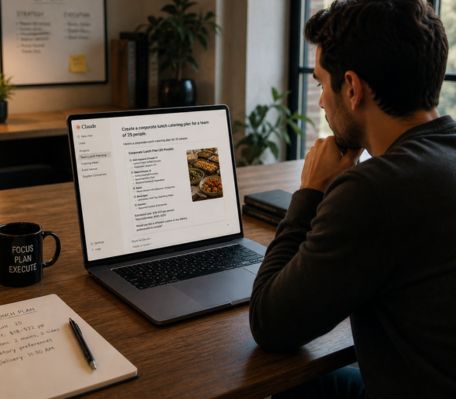
Running a restaurant means being pulled in ten directions at once. The kitchen, the staff, the vendors, the marketing, the reviews, the catering orders, the social media, the emails. Most restaurant owners are doing all of this themselves or with a small team that is already stretched thin.
Claude is an AI assistant built by Anthropic that can handle a significant portion of the writing, thinking, and planning work that currently fills your evenings and weekends. Not by replacing your judgment or your voice, but by doing the first draft, the research, the formatting, and the analysis so that the time you spend on those tasks drops from hours to minutes.
This is not about adopting complicated technology or changing how you run your kitchen. Claude works through a simple chat interface. You describe what you need, and it produces a draft you can edit, refine, and use. The learning curve is about as steep as sending a text message.
Here is a breakdown of the specific ways restaurant owners and catering operators are using Claude today to save time, improve their marketing, and grow their catering revenue.
What is Claude and how does it work?
Claude is an AI assistant developed by Anthropic, an AI safety company. It is accessible through a web browser at claude.ai and requires no software installation or technical setup. You type a question or a request, Claude responds. That is the entire interface. What makes Claude particularly useful for restaurant operators is its ability to understand context and produce output that sounds like a real person wrote it. You can give it background about your restaurant, your brand voice, your customers, and the specific task you need done, and it will produce something that requires minimal editing rather than a generic template that needs to be rewritten from scratch.
Claude can read documents you upload, help you think through problems, write in multiple formats, and remember the context of a conversation as it develops. For a restaurant owner who needs a marketing email, a staff policy update, a catering proposal, and a social media caption all in the same afternoon, it functions as the skilled generalist assistant most independent operators cannot afford to hire full-time.
1. Writing marketing content and social media captions
Marketing is one of the tasks that falls to the bottom of the list most consistently for restaurant owners. There is always something more urgent. The result is inconsistent posting, generic captions, and a social media presence that does not reflect the quality of the actual operation.
Claude can produce a week of social media captions in the time it takes to drink a coffee. You describe your restaurant, your upcoming specials, your tone, and the platform, and it produces options you can choose from, edit, and schedule. It is not replacing your creativity. It is removing the blank page problem that makes content creation feel harder than it needs to be.
Social media captions: Tell Claude: "Write three Instagram captions for a catering-focused restaurant promoting our new corporate lunch packages. Tone is professional but warm, not corporate. We serve offices of 20 to 100 people in Austin." It will produce multiple options in under ten seconds. You pick the one that sounds most like you, edit two words, and post it.
Email newsletters: Describe your seasonal menu update, your new catering offer, or your upcoming event and ask Claude to write a 200-word email to your client list. Give it your brand voice by pasting in a previous email you liked and asking it to match that style. The result is a ready-to-send draft that would have taken 45 minutes to write from scratch.
Google Business Profile posts: Weekly posts on your Google Business Profile improve local search visibility. Claude can generate a month of posts in one session if you give it your menu, your upcoming specials, and any seasonal catering availability. Each post takes about ten seconds to generate. Scheduling them takes five minutes.
Blog content for your catering website: SEO-optimised blog posts that help your catering website rank on Google require consistent publishing. Claude can draft a full blog post on any catering topic, written in your voice, formatted for SEO, and structured around the questions your ideal clients are actually searching for. What would take a freelance writer several hours and several hundred dollars takes Claude a few minutes.
2. Writing and optimising catering menus
Menu descriptions are harder to write than they look. The goal is to make food sound appealing without being overwrought, to communicate what is in a dish without listing every ingredient, and to reflect the quality of your cooking without sounding like you are overselling it. Most restaurant owners write menu copy that undersells their food simply because translating a dish into words is a different skill from preparing it.
Claude is exceptionally good at this. Give it the dish name, the key ingredients, and the tone you want, and it will produce a description that makes the food sound worth ordering.
Catering menu descriptions: Paste in your current menu item descriptions and ask Claude to rewrite them to sound more enticing while staying true to the actual dish. "Grilled chicken with lemon and vegetables" becomes "Herb-marinated chicken grilled to order, finished with a bright lemon butter and seasonal roasted vegetables." The food is the same. The description sells it.
Corporate catering package copy: The way you describe your catering packages to corporate buyers directly affects how many of them request a quote. Claude can rewrite your package descriptions to speak to the corporate buyer's actual concerns: reliability, dietary accommodation, group size flexibility, and on-time delivery. Package names and descriptions that sound professional and specific convert better than generic "Package A, Package B" structures.
Seasonal menu updates: When your catering menu changes with the season, Claude can rewrite the relevant sections quickly without you having to rebuild the entire document. Give it the new items and the format of the existing menu and it will produce updated copy that matches the style and quality of what is already there.
3. Writing catering proposals and client quotes
A well-written catering proposal is one of the highest-converting sales tools a catering operation can have. It demonstrates professionalism, anticipates the client's questions, and makes the decision to book easy. Most catering operators send quotes that are too brief, too generic, or formatted in a way that does not reflect the quality of their actual operation.
Claude can draft a complete catering proposal in minutes. Give it the event details, your menu options, your pricing, and any specific client requirements, and it will produce a structured, professional document that reads like something a full-time sales team would send.
Corporate catering proposals: For a new corporate account inquiry, ask Claude to write a proposal covering your catering formats, per-person pricing, dietary accommodation options, delivery and setup logistics, and a first-order incentive. The proposal should address the corporate buyer's primary concerns before they are asked. Claude will structure and write it. You review and send.
Event catering quotes: For a wedding or large private event inquiry, give Claude the details from the initial client conversation and ask it to draft a formal quote that covers menu options, service format, staffing, setup and teardown, payment terms, and next steps. A quote that anticipates every question the client has reduces the back-and-forth that slows the booking process.
Follow-up emails after a quote: Claude can write the follow-up messages that most catering operators never send. A check-in two days after a proposal goes out. A reminder before a quote expires. A re-engagement message for a prospect who went quiet. These messages recover a meaningful percentage of deals that would otherwise go cold.
4. Handling staff communications and operational writing
The back-office writing that accumulates in a restaurant operation, staff schedules, policy updates, vendor correspondence, job listings, training materials, and performance notes, takes time that most operators do not have. Claude handles all of it.
Staff memos and policy updates: Ask Claude to draft a staff memo about a new catering procedure, a change in uniform policy, or an update to opening and closing protocols. Give it the key points you want to cover and the tone you want to strike, and it will produce a clear, professionally written document that you can edit and distribute.
Vendor correspondence: Writing a firm but professional email to a produce vendor about inconsistent deliveries, or negotiating updated terms with a catering supply company, requires a tone that is assertive without being adversarial. Claude handles this well. Describe the situation, the outcome you want, and the relationship you want to preserve, and it will draft a message that communicates all three.
Job listings: A job listing that attracts quality applicants is specific about the role, honest about the environment, and clear about what you are looking for. Claude can write a catering coordinator listing, a kitchen staff posting, or a delivery driver job description that reads professionally and attracts the right candidates rather than a generic response to a generic listing.
Training documents: Standard operating procedures for catering prep, delivery protocols, client communication standards, and food safety checklists can all be drafted by Claude when you describe the process in plain language. Having these documented saves time in onboarding and reduces errors in execution.
5. Responding to client reviews and feedback
Responding to Google reviews is a direct local SEO signal and a visible demonstration of how your catering operation treats clients. Most restaurant owners either do not respond at all, or respond with the same generic acknowledgment that provides no SEO value and no real engagement with what the reviewer said.
Claude can write personalised, professional responses to every review in minutes. Paste in the review text, describe your restaurant briefly, and ask for a response that acknowledges the specific feedback, thanks the reviewer, and naturally includes a location and service keyword. For negative reviews, Claude can draft a response that addresses the concern without being defensive and demonstrates that the feedback has been heard.
A month's worth of review responses, written personally and specifically, can be handled in a single 20-minute session with Claude. That consistency in review engagement builds both SEO credibility and the kind of visible professionalism that converts prospects who read your reviews before making contact.
6. Writing catering sales outreach and cold email sequences
Reaching out to local businesses to pitch your catering service requires copy that does not sound like a pitch. The office manager or HR coordinator on the receiving end has seen hundreds of vendor emails. A message that leads with your menu or your prices gets deleted. A message that speaks to their problem, the difficulty of finding a reliable caterer they can trust, gets read.
Claude can write outreach emails, LinkedIn messages, and follow-up sequences that sound like they came from a person rather than a template. Give it context about who you are, who you are reaching out to, and what you want the message to accomplish, and it will produce copy that is conversational, specific, and appropriately persistent without being pushy.
Cold outreach emails: Ask Claude to write a short, direct cold email to an office manager at a local company introducing your corporate catering service. Brief, no jargon, soft call to action. Claude will produce a first draft that you can personalise with specific company details before sending.
Follow-up sequences: A five-email sequence that nurtures a cold lead over three weeks, moving from introduction to social proof to first-order offer, can be drafted by Claude in a single session. Give it the audience, the goal of each email, and your brand voice, and it will produce the full sequence ready to load into your email platform.
LinkedIn outreach messages: Short, conversational LinkedIn messages to office managers and event planners in your city can be drafted by Claude using the same approach. The platform rewards brevity and a human tone. Claude produces both.
7. Analysing catering performance and client data
Claude can read documents, spreadsheets, and data you paste into the conversation and help you make sense of what it means for your business. For a catering operator, this opens up analysis capabilities that would otherwise require a dedicated analyst or hours of manual work.
Client reorder analysis: Paste a list of your catering accounts, their last order dates, and their average order values into Claude and ask it to identify which accounts have not reordered in 30 days and are worth a re-engagement message. It will produce a prioritised list and draft the outreach messages simultaneously.
Review theme analysis: Paste in your last 20 Google reviews and ask Claude to summarise the most common themes in positive and negative feedback. This turns a time-consuming qualitative task into a two-minute exercise that gives you actionable insight into what your catering operation is doing well and where it is losing clients.
Menu performance questions: Ask Claude to help you think through which catering menu items are worth keeping, cutting, or promoting based on the order data you share with it. It cannot access your POS system directly, but it can analyse any data you paste in and help you draw conclusions that inform your next menu update.
Claude is the generalist assistant most restaurant owners cannot afford to hire
A skilled marketing writer, a professional copywriter, a proposal specialist, a data analyst, and a back-office administrator would collectively cost more per month than most independent restaurant operators earn in margin. Claude does not replace any of those roles entirely. But it handles the first draft of almost everything those roles produce, which means a single operator can accomplish the output of a small team without the overhead.
The restaurant owners who are getting the most out of Claude are not the ones who have fully automated their operations. They are the ones who use it for the specific tasks that currently eat the most time: writing that could be drafted faster, communications that could be more professional, and marketing that could be more consistent.
Start with one task. A social media caption you have been putting off. A follow-up email to a catering prospect that went quiet. A menu description that has never quite captured what the dish actually tastes like. Claude takes ten seconds to produce a first draft. You spend two minutes editing it. The result is better than what you would have written from scratch, and it took a fraction of the time.
That is the value. Not automation. Not replacement. A faster path from intention to execution on the writing and thinking work that is currently slowing your restaurant down.
Frequently Asked Questions
How can restaurant owners use Claude to save time?
Restaurant owners use Claude to draft social media captions, write marketing emails, produce catering proposals, respond to client reviews, write staff memos, draft vendor correspondence, create job listings, and analyse client data. Tasks that previously took 30 to 60 minutes of writing time often take under five minutes when Claude produces the first draft and the owner edits for tone and specificity.
Can Claude write catering proposals and quotes?
Yes. Claude can draft a complete catering proposal when given the event details, menu options, pricing, and any specific client requirements. The output is a structured, professionally written document that addresses the buyer's likely questions before they are asked. It can also write follow-up emails, re-engagement messages for lapsed quotes, and personalised check-ins that most catering operators never send.
Can Claude help with catering sales outreach?
Yes. Claude can write cold outreach emails to office managers and HR coordinators, LinkedIn messages targeting corporate catering buyers, and multi-email follow-up sequences designed to nurture a cold lead into a first booking. The output can be personalised with specific company details before sending and adjusted to match any tone or brand voice.
Is Claude difficult to use for restaurant owners who are not technical?
No. Claude operates through a simple chat interface at claude.ai. You type what you need in plain language, the same way you would describe a task to an assistant, and Claude responds. There is no software to install, no technical setup, and no learning curve beyond becoming comfortable describing what you want in a few sentences.
How does Claude help with catering menu writing?
Claude can rewrite menu item descriptions to sound more appealing, draft copy for new corporate catering packages, and update seasonal menu sections when offerings change. You provide the dish name, key ingredients, and the tone you want. Claude produces a description that makes the food sound worth ordering. The result typically requires minimal editing and significantly outperforms generic self-written descriptions in how well it communicates the quality of the food.
Can Claude analyse catering client data?
Yes, within a conversation. You can paste in client lists, order histories, review text, or any other data and ask Claude to identify patterns, prioritise follow-up, summarise themes, or help you draw conclusions. It cannot connect directly to your POS system or CRM, but any data you can copy and paste into the conversation can be analysed and acted on.

.png)
.svg)


.png)

