
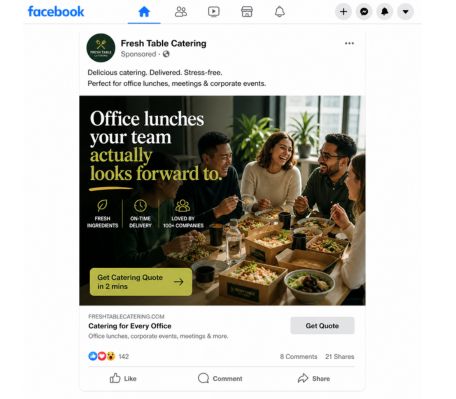
Most restaurant owners who try Facebook Ads for catering run the same ad. A photo of the food, a headline that says something like "Order catering now," and a link to the website. Then they wonder why the results are disappointing.
The problem is not Facebook. The problem is the strategy. An ad asking for an immediate sale only converts the tiny fraction of people who happen to need catering at that exact moment. Everyone else scrolls past it. For a market as specific as corporate catering, where the buyer is an office manager or HR coordinator with a defined need and a decision-making process, that approach misses almost everyone worth reaching.
High-ticket catering orders, ranging from several hundred to several thousand dollars per event, do not come from impulse clicks. They come from relationships built over multiple touchpoints with the right buyers. Facebook Ads, used correctly, is one of the most efficient ways to build those relationships at scale and at a cost that would be impossible through any traditional outreach method.
This is a four-step Facebook Ads strategy specifically designed to build a database of qualified corporate catering prospects and convert them into repeat clients. Here is how it works.
Why Facebook Ads work differently for catering than for dine-in
Facebook Ads for a restaurant promoting dine-in traffic are largely an awareness play. You are putting the restaurant in front of people who might visit sometime. The conversion is indirect and delayed.
For catering, the dynamic is different. The buyer you are trying to reach, an office manager, executive assistant, or HR coordinator, is a specific, identifiable person with a recurring professional need. Facebook's targeting tools allow you to reach people by job title, employer size, industry, and location. You can build an audience of exactly the type of buyer who controls corporate catering decisions in your city and put your offer directly in front of them.
The other difference is the nature of the sale. A corporate catering account that places weekly lunch orders for 30 people is worth thousands of dollars per year. The economics of acquiring that client through Facebook Ads, even at a relatively high cost per lead, work strongly in your favor. Spending $50 in ads to acquire a client worth $3000 annually is not an ad cost. It is an investment with a measurable return.
Step 1: Run objective-specific ads across three stages
Most restaurant owners run one ad and hope it does everything. It does not. A buyer who has never heard of your restaurant and a buyer who has already watched your video and visited your website need completely different messages. Treating them the same way wastes budget and misses both.
Facebook's campaign objective system is built around the buyer journey. Awareness campaigns reach new audiences. Consideration campaigns build familiarity and capture intent. Conversion campaigns ask for the action. Running all three in sequence is what separates a catering Facebook strategy that compounds from one that produces a handful of clicks and nothing else.
Awareness: Build trust through video ads
The awareness stage is not the place to sell. It is the place to be seen and remembered. The most effective awareness ad format for corporate catering is a short video from the restaurant owner speaking directly to camera. Not a polished brand video. A real person, in the restaurant, introducing themselves and explaining who they serve.
An office manager who has never heard of your restaurant will scroll past a food photo without a second thought. She will pause on a video of someone talking directly to her. That directness creates a moment of recognition that no static creative can replicate. Sixty to ninety seconds is enough. The structure is simple: who you are, what you do, who you serve, and one low-pressure ask. Keep the production simple. Phone camera, good natural light, a clean background. Over-produced video loses the authenticity that makes this format work.
Set this campaign to the Video Views or Brand Awareness objective. The goal at this stage is reach and recall, not leads. You are building the audience that the next two campaigns will convert.
Consideration: Traffic and engagement ads
Once someone has watched your awareness video, they move into your consideration audience. Facebook automatically tracks who has watched 25, 50, or 75 percent of your video, and you can retarget those viewers specifically with the next stage of the campaign.
Consideration ads should go deeper. A carousel of your best catering setups. A short testimonial from a corporate client. A behind-the-scenes look at how a large office order is prepared and delivered. The goal is to move a warm viewer from "I've seen this restaurant" to "this looks like the kind of operation I could trust with a 50-person lunch."
Set this campaign to the Traffic or Engagement objective and send clicks to your dedicated catering landing page. The buyer is not ready to submit their details yet. They are still evaluating. Give them something worth evaluating.
Conversion: Facebook Lead Ads
The conversion stage is where Lead Ads come in. A Lead Ad keeps the user on Facebook rather than redirecting them to an external website. The contact form appears directly within the platform, and because Meta already has the user's profile data, it autofills their first name, last name, email, and phone number automatically. Two clicks and they are done.
That frictionless process is why Lead Ads produce significantly lower cost per lead than standard link-click ads. Fewer steps between interest and submission means a higher percentage of people who see the ad actually complete it.
Target this campaign tightly. Reach people by job title: office managers, executive assistants, HR coordinators, event coordinators, and operations managers within a defined radius of your restaurant. Layer on employer size if your ideal client is a company with more than 20 employees. This precision ensures your conversion ad is reaching the actual decision-makers for corporate catering budgets, not general consumers who happened to watch your video.
Step 2: Ask qualifying questions that tell you exactly who your best prospects are
The Facebook Lead Ad form autofills the contact basics. What it cannot fill in automatically is the information that tells you whether this lead is worth a personal follow-up or a standard automated email sequence. That is where custom qualifying questions earn their value.
Adding two or three short custom questions to your lead form takes the entry from a contact to a qualified prospect profile. The questions should be easy to answer, non-intrusive, and directly relevant to catering potential.
Business name: Knowing which company the prospect works for lets you research the organisation before reaching out. A quick look at their LinkedIn page tells you how many employees they have, what industry they are in, and whether their office culture suggests regular catering spend. This turns a cold lead into a warm one before the first contact.
Number of employees: Group size is the single most useful data point for prioritising catering leads. An office with 50 employees placing a weekly lunch order represents dramatically more revenue potential than an office with 8. Offer simple ranges as multiple-choice answers to reduce friction: 1 to 10, 11 to 25, 26 to 50, 51 to 100, 100 or more. This single question lets you segment your entire lead list by revenue potential before sending a single follow-up message.
How often they order catering: Frequency of catering orders distinguishes one-time event buyers from recurring corporate accounts. A prospect who orders catering monthly is worth far more over a year than one who orders twice a year for the holiday party. Options like "Weekly," "A few times a month," "Monthly," "A few times a year," and "Rarely" give you a clean segmentation framework for how aggressively to pursue each lead.
Together, these three data points give you a lead list that is not just a collection of names and email addresses. It is a ranked database of local businesses by catering potential, built at a fraction of the cost of any traditional prospecting method.
Step 3: Automate email sequence that builds the relationship
Collecting qualified leads is the beginning, not the end. The vast majority of people who enter your form are not ready to place a catering order the day they submit the form. They entered because they wanted to explore or the offer was low-risk and appealing. Your job now is to stay present, build trust, and be the obvious choice when they next need a caterer.
An automated email sequence, set up to trigger immediately when a new lead enters your Facebook form, does this work without requiring any manual effort on your end. Connect your Facebook Lead Ad to an email marketing platform such as Mailchimp, Klaviyo, or ActiveCampaign using a simple automation tool, and build a sequence of around ten emails that drip out over five weeks.
Personalise every email with the prospect's first name in the greeting. Include your logo and brand colors consistently so each email reinforces visual recognition. Food photography that makes the product look genuinely appealing is worth more than any amount of copy in this context.
Step 4: Layer personal outreach on top of the automated sequence for your best prospects
Automation handles the volume. Personal outreach wins the high-value accounts.
Because you collected phone numbers in the lead form, you have the ability to reach prospects through a channel that most of your competitors are not using alongside email. A short, direct text message from the restaurant owner sent during the email sequence creates a level of personal attention that an automated email can never replicate. When a prospect receives a text from the owner of the catering operation, it signals that their business matters and that this is not a faceless corporation sending bulk messages.
The text does not need to be long or elaborate. Something as direct as "Hi Sarah, this is Preet from [restaurant]. Would love to set up a tasting for your team when you have a chance" is personal, low-pressure, and gives the prospect an easy way to respond.
Use the qualifying data you collected to decide which prospects receive personal outreach versus automated follow-up only.
High-priority prospects: Leads who indicated 20 or more employees and order catering at least monthly represent your highest-revenue potential accounts. These are worth a personal phone call in addition to the text and email sequence. A brief call from the restaurant owner to introduce themselves and offer a complimentary tasting is an unusual enough gesture that it stands out in the prospect's inbox and memory. Most of your competitors are not making these calls.
Mid-priority prospects: Leads from offices with 10 to 20 employees who order occasionally are worth an automated email sequence plus one or two personal text messages at strategic moments in the sequence.
Lower-priority prospects: Small offices that order rarely are worth keeping in the email sequence and nothing more. They are unlikely to become high-value accounts quickly, but they cost nothing to maintain in the sequence and may become more frequent orders over time as their company grows or their catering habits change.
This tiered approach ensures that your personal time and energy go toward the prospects with the highest potential return while automation handles everyone else. The combination of an email sequence and personal outreach consistently outperforms either channel in isolation.
Add retargeting to re-engage prospects who go quiet
Not every lead who fills the form will respond to the email sequence or the personal outreach. Some will open a few emails and go quiet. Some will not open any. This is normal, and it does not mean those leads are lost.
Facebook's custom audience feature allows you to upload your lead list and serve retargeting ads specifically to people on that list. A prospect who went quiet after your email sequence will start seeing your catering ads in their Facebook and Instagram feed, which reintroduces your restaurant without any direct outreach effort.
Retargeting ads for a warm audience do not need to work as hard as cold prospecting ads. These people already know who you are. A simple reminder, a seasonal offer, a new menu item, or a "we still have availability for [month] office lunches" message is often enough to restart a conversation that the email sequence did not close on its own.
Facebook Ads for catering is a relationship-building system, not a sales channel
The shift that makes this strategy work is treating Facebook Ads as the beginning of a relationship rather than the moment of a sale. It is an introduction. The email sequence, the personal texts, the calls to high-value prospects, and the retargeting ads are all touchpoints that build the familiarity and trust that eventually produce a first catering order.
Once that first order is placed and executed well, the relationship compounds. A satisfied corporate client reorders. They refer colleagues. They become the kind of account that generates consistent revenue without any ongoing acquisition cost.
The Facebook ad brought them in. The system that follows turned them into a client. Build both and the results are not a one-time campaign outcome. They are a repeatable pipeline.
Frequently Asked Questions
Why do standard Facebook Ads not work for high-ticket catering?
A direct "order now" ad only converts the small fraction of buyers who need catering at that exact moment. For high-ticket corporate catering orders, buyers have a decision-making process that involves multiple touchpoints. A strategy built around lead generation, qualification, and a follow-up sequence converts a far higher percentage of the relevant audience than a single-ad approach.
What are Facebook Lead Ads and why are they effective for catering?
Facebook Lead Ads are a specific ad format that displays a lead capture form directly within Facebook or Instagram rather than redirecting users to an external website. Because Meta autofills the contact information from the user's profile, the form can be completed in two clicks. This frictionless process produces significantly higher submission rates and lower cost per lead than standard link-click ads.
What qualifying questions should a catering business ask in a Facebook lead form?
Business name, number of employees, and catering order frequency are the three most useful qualifying questions for a corporate catering lead form. Together they tell you the prospect's revenue potential and how aggressively to pursue them with personal follow-up versus automated email sequences.
How do you prioritise personal outreach from a Facebook catering lead campaign?
Use the qualifying data collected in the lead form to segment prospects by revenue potential. Leads from offices with 20 or more employees who order catering frequently are worth a personal phone call. Mid-sized offices warrant one or two personal text messages during the email sequence. Smaller or infrequent accounts are well served by the automated sequence alone.
What is Facebook retargeting and how does it help convert catering leads?
Facebook retargeting serves ads to people who have already interacted with your business, such as leads who filled the form but did not respond to the email sequence. By uploading your lead list as a custom audience, you can show targeted catering ads specifically to warm prospects who already know your brand. Retargeting ads require less persuasion than cold prospecting ads and often restart conversations that the email sequence did not close.
What should a first-order incentive look like for a corporate catering prospect?
The incentive should be relevant to the corporate buyer rather than the individual. A free add-on with the first office order, a complimentary delivery, or a welcome credit applied to the first booking all work well. Avoid food-based personal rewards that benefit the individual rather than their team. The goal is to make the first order feel low-risk and immediately valuable to the person making the catering decision.

.png)
.svg)


.png)

