

Finding catering buyers through cold outreach is one of the highest-return prospecting strategies available to a catering business. An office manager placing a weekly lunch order for 50 people is worth potentially tens of thousands of dollars annually. A single outbound email that converts that prospect into a direct client more than pays for itself many times over.
The problem is that most catering operators have no system for finding these buyers at scale. Referrals arrive when they feel like it. Marketplace platforms charge 18 to 30% commission and own the client relationship. Cold outreach, done well, is the one channel that lets you build a direct pipeline of qualified catering buyers on your own terms.
The challenge is the first step: getting in front of the right people with accurate contact information. Office managers, executive assistants, HR coordinators, and event planners are not hard to find on LinkedIn. Getting their verified email address, the one that will actually reach them and not bounce, is where most operators run into difficulty.
Email list building tools solve this. They let you identify catering buyers by job title, company size, and location, and surface verified contact information that makes cold outreach possible at scale. Here is an honest breakdown of the most relevant tools, what each one does well, and where each one falls short for a catering operator building an outbound pipeline.
Why finding catering buyers through cold outreach is harder than it looks
The catering buyer is a specific person inside a specific type of organisation. You are not trying to reach a company broadly. You are trying to reach the individual inside that company whose job involves organising food for groups of people. That is usually an office manager, executive assistant, HR coordinator, or dedicated event planner.
That specificity is both the challenge and the opportunity. It is a challenge because generic business databases are not optimised around job functions like catering coordination. It is an opportunity because if you can identify those specific roles at companies within your delivery radius, the conversion rate from a well-written first outreach is significantly higher than most marketing channels.
The practical difficulties come down to three things. First, finding companies that are the right size to have regular catering needs, typically organisations with 20 or more employees. Second, identifying the specific person at each company who makes or influences catering decisions. Third, getting a verified email address for that person that will actually reach their inbox rather than bounce or go to a catch-all address that never gets monitored.
The tools below address these three problems in different ways, with different trade-offs between ease of use, data quality, and the level of technical setup required. None of them are perfect for the catering use case specifically. All of them are meaningfully better than building a prospect list manually.
How to use filters to find catering buyers specifically
The value of any prospecting tool is only as good as the filters you apply inside it. A broad search for businesses in your city will return thousands of irrelevant results. A tightly filtered search built around the characteristics of a corporate catering buyer will return a manageable, high-quality list you can actually work through.
Knowing which filters matter for catering prospecting specifically is what separates a useful prospect list from a waste of time. Here is how to think about each filter dimension.
Job title filters: The most important filter. You are looking for the specific person who controls catering decisions, not a general business contact. Target: Office Manager, Executive Assistant, Administrative Manager, HR Coordinator, HR Manager, People Operations Manager, Office Operations, Events Coordinator, Corporate Event Planner, Facilities Manager, and EA or Admin at Director or VP level. Each of these roles regularly manages food ordering for groups. Use multiple title variations because the same function is described differently across companies.
Company size filters: Corporate catering demand scales with headcount. Companies with fewer than 15 employees rarely have a regular catering budget. Companies with 20 to 200 employees are the sweet spot for consistent weekly or monthly orders. Companies with 200 or more employees often have multiple office managers and higher order volumes. Filter your search to match the order sizes your kitchen can handle and your delivery logistics can support.
Geographic filters: Your delivery radius is the single most important constraint on your prospect list. There is no point building a list of 500 office managers in a city you cannot serve. Every tool on this list supports geographic filtering at minimum by city, and most support filtering by zip code radius. Set your delivery radius honestly and filter within it. A smaller, geographically accurate list outperforms a large, geographically scattered one every time.
Industry filters: Some industries generate more regular catering demand than others. Technology companies, financial services firms, law firms, consulting organisations, and healthcare administration offices all have cultures of regular team meals, client lunches, and all-hands catering. Filtering by industry lets you prioritise the sectors where catering is already a normal business expense rather than an exceptional one.
Seniority filters: In corporate catering, the decision-maker is rarely the most senior person in the building. An EA to the CEO and an office manager with five years at the company have similar catering authority but very different seniority levels. Filter for the coordinator and manager level rather than director and above. Senior leadership sets budgets but rarely places the actual orders.
1. Apollo.io : Best all-in-one option for most catering operators
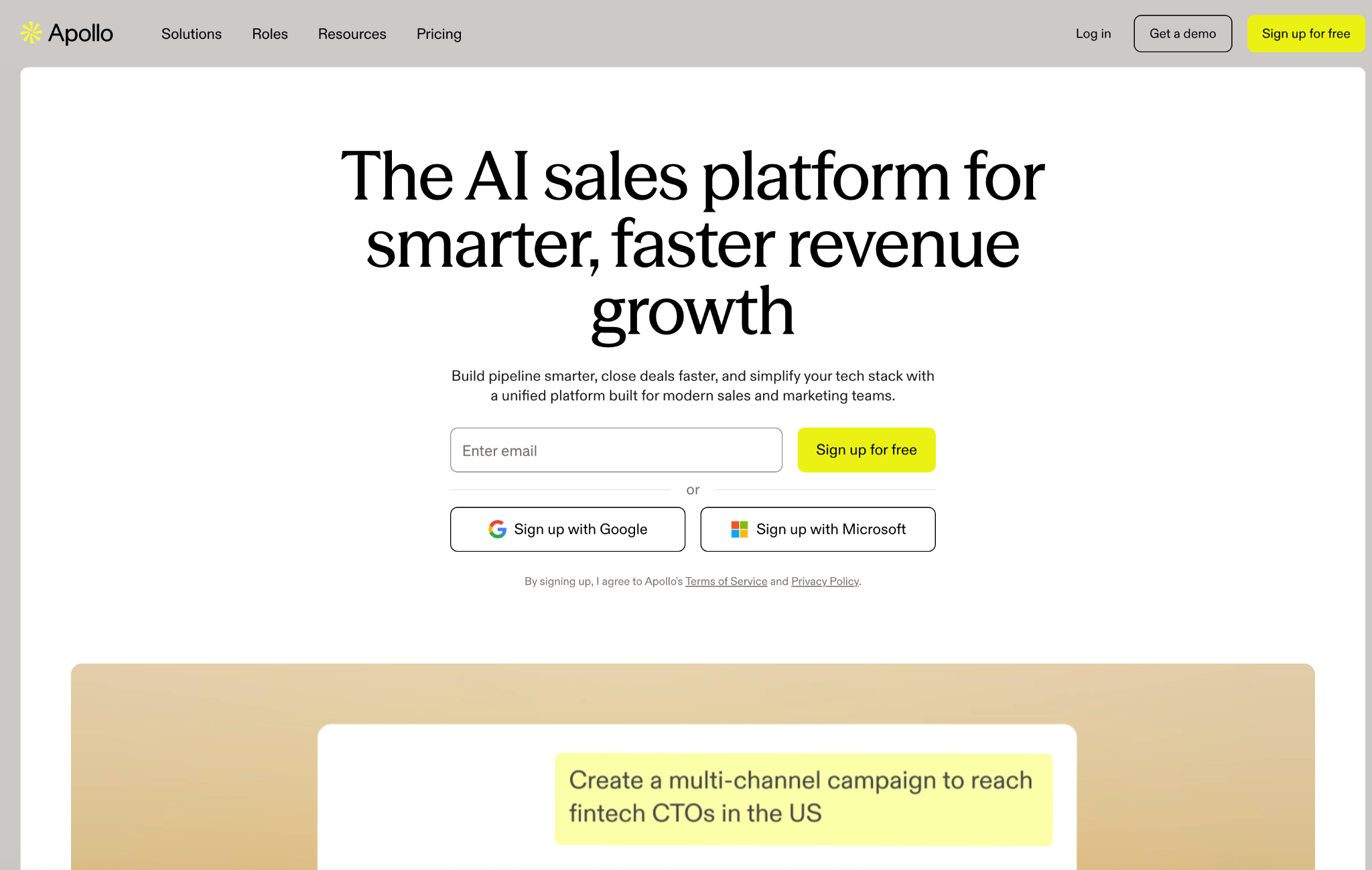
Apollo.io combines a database of over 275 million contacts with built-in email sequencing, which means you can find a catering buyer, verify their email, and send them an outreach sequence all within the same platform. For a catering operator building a cold outreach pipeline for the first time, the combination of prospecting and outreach in one place removes significant friction.
The contact search is filtered by job title, location, company size, industry, and seniority, which maps cleanly to the targeting dimensions described above. A search for office managers at companies with 20 to 200 employees within a 30-mile radius of your city will return a usable prospect list in minutes.
What it does well: The combination of database and sequencing in one tool removes the need to manage multiple platforms for prospecting and outreach. The contact search filters are granular enough to identify the specific buyer roles relevant to corporate catering. A free plan lets you test the workflow before committing.
Limitations: Mobile number coverage is limited for most markets, which matters if you want to follow up cold emails with a phone call. Data accuracy for direct dials is weaker than ZoomInfo. Customer support has consistently poor reviews across G2 and Reddit. Apollo's LinkedIn company page was delisted in early 2025 due to reported LinkedIn policy violations, which is worth noting if LinkedIn integration is part of your workflow.
Best for: Catering operators who want an all-in-one prospecting and outreach platform without managing multiple subscriptions. The most practical starting point for a catering business building its first cold outreach pipeline.
2. Clay : Most powerful for custom enrichment and hyper-local targeting
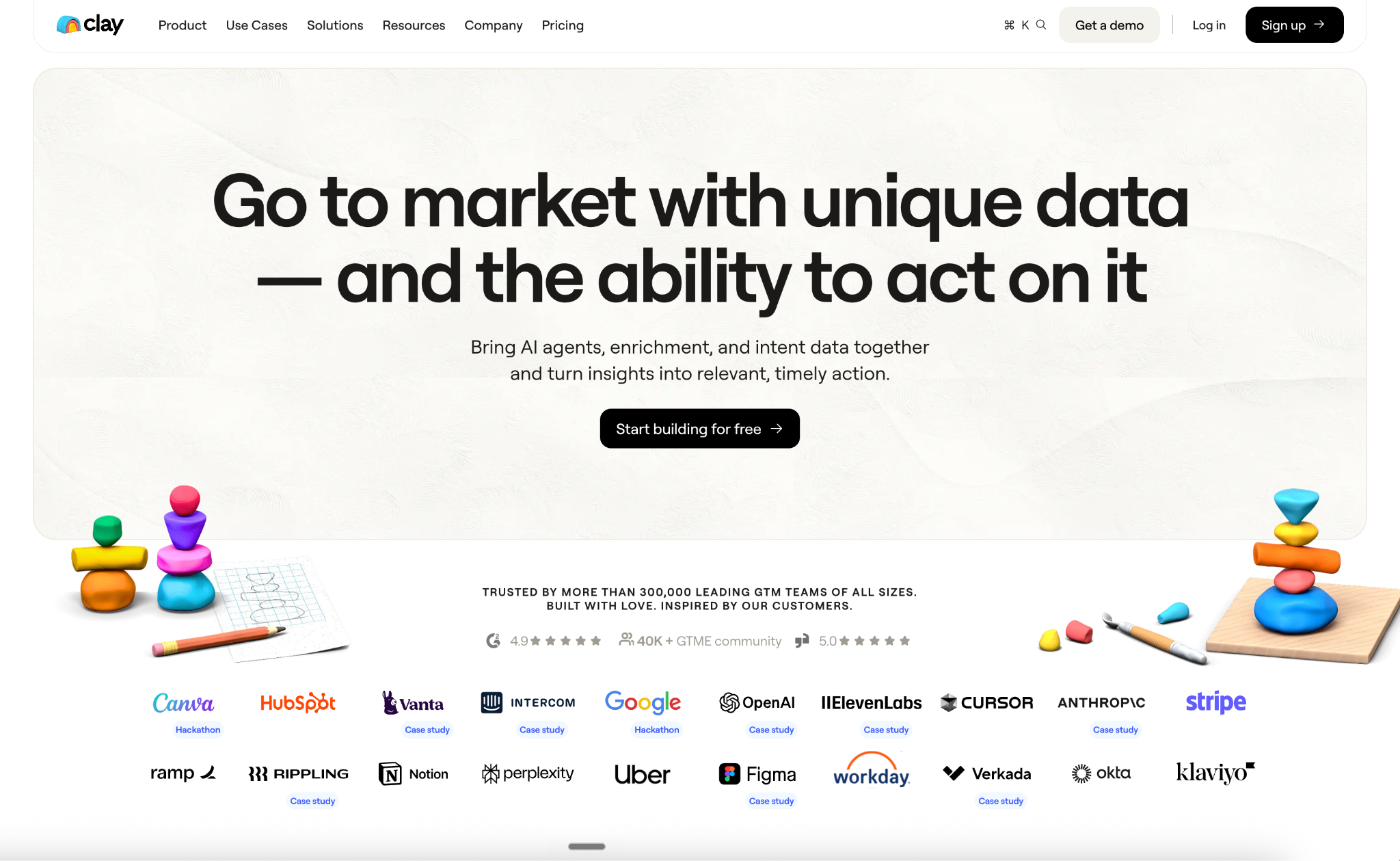
Clay is a data orchestration platform that pulls from over 100 different data providers through a single spreadsheet-like interface. Rather than relying on a single database, Clay runs waterfall enrichment: it checks multiple sources in sequence until it finds a verified result. For catering prospecting specifically, Clay's ability to pull from Google Maps and other location-based data sources makes it uniquely powerful for hyper-local targeting.
A catering operator targeting a specific office park, business district, or set of buildings can use Clay to identify every company at those addresses through Google Maps data, cross-reference company headcount from multiple sources, identify the office manager or HR coordinator at each company, and enrich the list with verified email addresses, all in a single automated workflow. That level of geographic and organisational precision is not available in any simpler tool.
Clay's advanced filters and data sources: Clay goes significantly further than standard database filters. Because it connects to over 100 data sources, Clay can enrich prospect lists with data that no single-source tool can provide. It can pull from Google Maps to identify businesses at specific addresses, cross-reference company data from multiple sources simultaneously, and flag companies by specific signals like recent office moves, team expansions, or hiring patterns that suggest a growing headcount and therefore growing catering potential. For an operator targeting a specific business district or office park, Clay can surface every company in that area, identify the relevant decision-maker, and enrich the contact with verified email data, all in a single automated workflow. This level of targeting specificity is not available in any simpler tool.
What it does well: Waterfall enrichment from 100+ sources produces contact data coverage that single-source tools cannot match. Google Maps integration lets you prospect by physical location, which is uniquely useful for catering businesses targeting specific office buildings or business districts within their delivery radius. Deeply customised enrichment logic can be built around any combination of filters relevant to catering buyers. Does not charge per seat, which is cost-effective for teams.
Limitations: Clay has a steep learning curve that requires RevOps or technical knowledge to use effectively. It is a data orchestration platform, not a prospecting interface with a simple search bar. Most independent catering operators will need support building workflows initially. For a restaurant owner building their first outbound pipeline, Clay is likely more tool than the situation requires unless technical help is available.
Best for: Catering operators who want to target specific geographic areas with precision, have access to technical support for workflow setup, and are prospecting at a volume that justifies the investment. The most powerful option on this list for hyper-local catering prospecting.
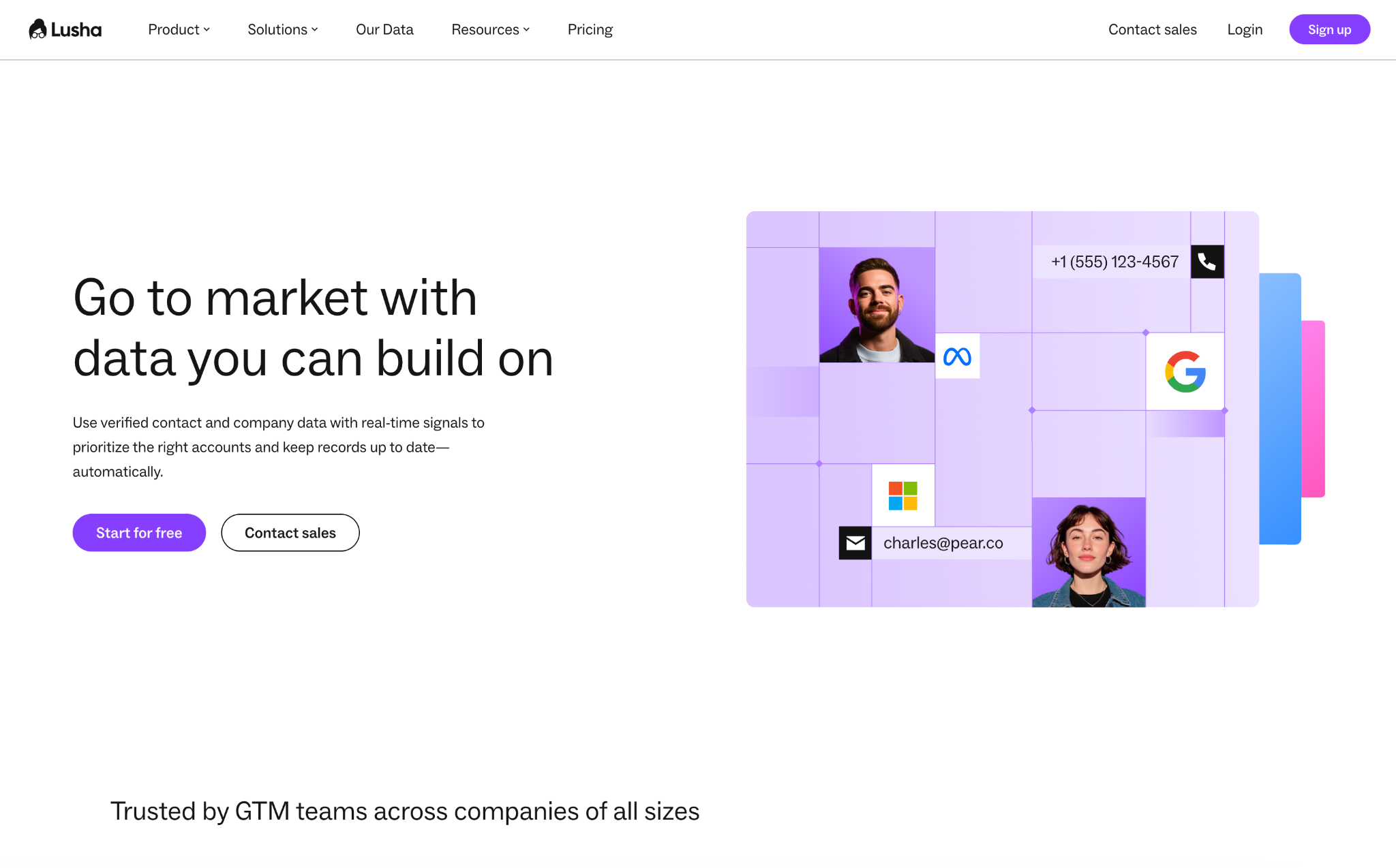
3. Lusha : Fastest way to enrich LinkedIn contacts with verified emails
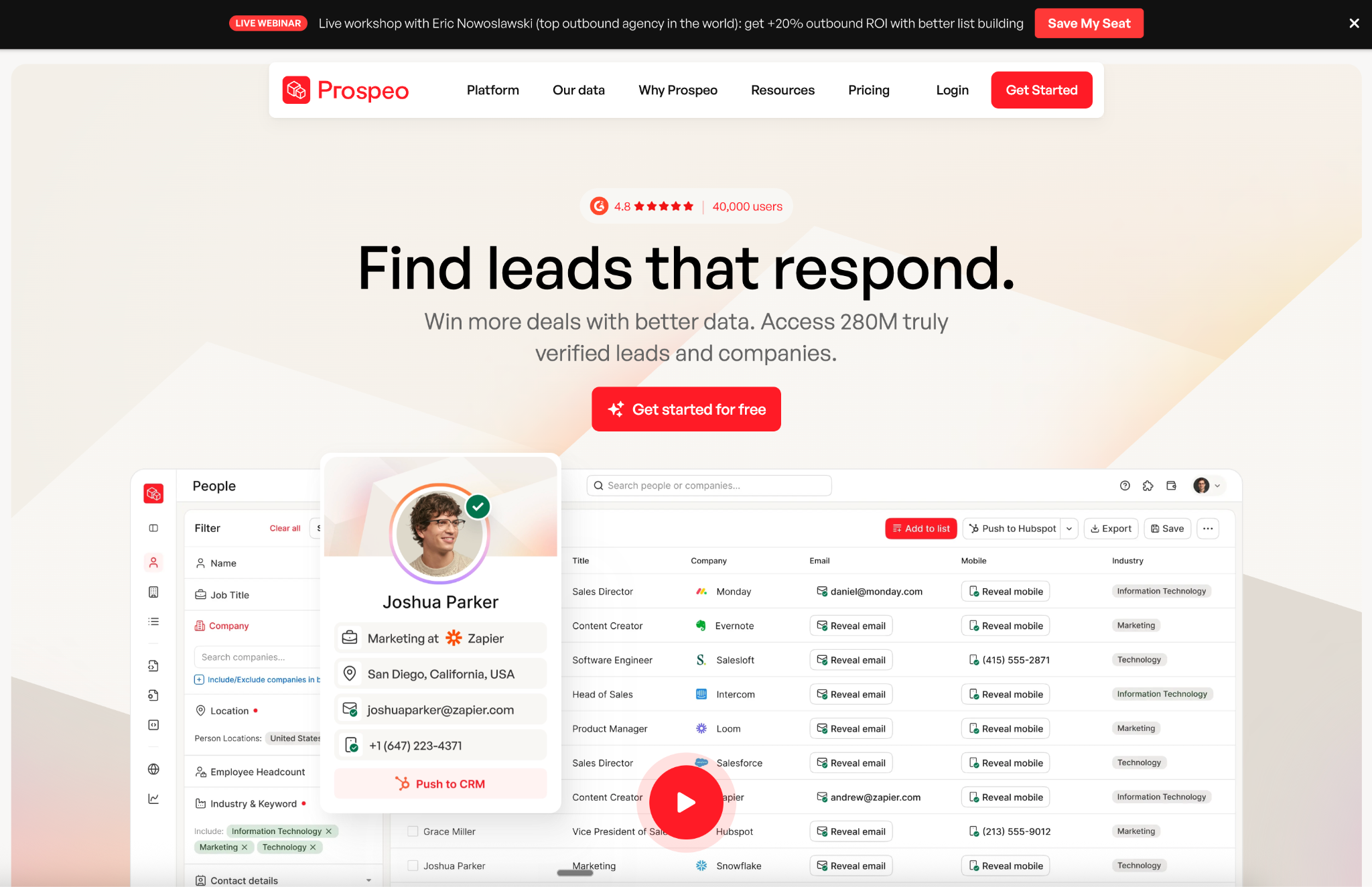
Prospeo is a B2B contact data tool built around finding and verifying professional email addresses and mobile numbers. Its core capabilities cover four areas: an email finder that locates addresses by name and company, a domain search that pulls multiple emails associated with any company website, a bulk upload processor for enriching large contact lists, and a Chrome extension that surfaces verified contact data from any website or LinkedIn profile with a single click.
What it does well: Prospeo's headline differentiator is data accuracy. Its 5-step verification process delivers a claimed 98% email accuracy with a 7-day data refresh cycle, which is roughly six times faster than the industry average of around six weeks. That refresh frequency matters in practice because contact data decays quickly and a list verified last month is already partially stale. The credit model is also notably fair: you only pay for valid results. If Prospeo cannot find a verified email, no credit is charged, which keeps the cost per usable lead predictable.
Limitations: Prospeo does not have a searchable prospect database the way Apollo does. It is an enrichment and verification tool, not a prospecting interface. You bring the contact list or profile, and Prospeo finds and verifies the email. Some users report inconsistent results on bulk domain searches compared to individual lookups, and the platform lacks a backend search feature that would let you build lists from scratch without an external source.
Best for: Catering operators who want high-accuracy email verification and enrichment for contact lists they have already built through LinkedIn, a database like Apollo, or manual research. Works well as a verification layer on top of any other list-building tool to reduce bounce rates before sending outreach campaigns.
4. Prospeo : Reliable email finder and verifier with strong accuracy
The credit model is notably fair: you only pay for valid results. If the tool cannot find a verified email for a contact, no credit is charged. This keeps the cost per usable lead predictable.
What it does well: The Sales Navigator export integration is the standout feature. Build a filtered list in Sales Navigator, export it, and Prospeo enriches the list with verified emails. The Chrome extension has a strong user rating and over 40,000 active users. Only valid results consume credits, which prevents the credit waste common in competing tools.
Limitations: Bulk processing is where Prospeo underperforms. Independent tests report bulk Sales Navigator exports returning match rates as low as 4.5% to 30%, meaning a significant portion of credits can be consumed without usable results. One independent benchmark ranked Prospeo last among eight tools tested for verified email coverage on bulk datasets. For individual Chrome extension lookups the accuracy is strong. For large-scale bulk processing the economics can break down.
Best for: Catering operators who use LinkedIn Sales Navigator and want an affordable way to enrich moderate-sized export lists with verified emails. Less suited to bulk processing very large prospect databases.
5. ZoomInfo : Most comprehensive database, enterprise scale
For a catering business, ZoomInfo's data depth is genuinely impressive. The quality of its direct dial phone numbers is consistently rated above every competitor. Intent data that surfaces companies actively planning events or expanding their office footprint could flag high-potential catering prospects before they start actively searching for a vendor.
What it does well: The largest and most frequently refreshed B2B contact database available. Direct dial phone number accuracy is best in class, significantly outperforming every other tool on this list. Intent data helps large teams prioritise accounts based on active buying signals. Integrates with every major CRM and sales engagement platform.
Limitations: ZoomInfo is an enterprise product with enterprise pricing that is not disclosed publicly and typically requires a lengthy negotiation. Multiple independent reviews note that ZoomInfo contracts can be difficult to exit and pricing is opaque. For an independent catering operator or small restaurant group, ZoomInfo is almost certainly not the right investment at this stage.
Best for: Restaurant groups or franchise organisations with a dedicated sales team, a significant catering revenue target, and the budget to justify enterprise tooling. Not relevant for most independent catering operators.
Which tool should a catering business start with?
For most catering operators building their first outbound pipeline, Apollo.io is the most practical starting point. It combines contact search, email verification, and outreach sequencing in one platform, which means you can test the entire workflow without managing multiple subscriptions or learning multiple tools simultaneously.
If hyper-local targeting is a priority, meaning you want to prospect within a specific business district, set of office buildings, or delivery zone rather than a broad city search, Clay is worth the investment if technical support is available. The Google Maps integration and multi-source waterfall enrichment give Clay a targeting precision that Apollo cannot match for location-specific catering prospecting.
If you are already spending time on LinkedIn identifying prospects manually, adding Lusha or Prospeo to your existing workflow removes the most time-consuming step without requiring you to change how you find prospects in the first place.
ZoomInfo is worth evaluating if you are part of a larger organisation with enterprise sales requirements. For independent operators, the data quality advantage does not justify the cost when Apollo or the LinkedIn plus Lusha combination delivers sufficient quality for catering outreach.
Regardless of which tool you start with, the quality of your outreach copy matters as much as the quality of your list. A verified email to the right person is only the first step. A short, specific, non-salesy message that speaks directly to the office manager's actual problem, finding a reliable caterer they can stop worrying about, is what converts the contact into a conversation.
The pipeline you build today compounds tomorrow
Cold outreach to catering buyers is not a one-time campaign. It is a pipeline that compounds. A targeted list of verified office managers in your city, contacted with a well-written sequence over three to four weeks, will produce some first orders. Those first orders, executed well and followed up with a loyalty program that rewards the individual buyer directly, produce recurring accounts. Those recurring accounts refer colleagues.
The initial outreach cost becomes the acquisition cost for a client relationship worth years of revenue. The tools in this guide give you the infrastructure to build that pipeline systematically. Start with the one that matches your current setup and technical comfort level. Build the list. Write the outreach. Execute the first orders well. The compounding takes care of itself from there.
Frequently Asked Questions
What are catering buyers and how do you find them?
Catering buyers are the individuals inside organisations who make or influence decisions about ordering catering for corporate events, office lunches, and workplace gatherings. They are typically office managers, executive assistants, HR coordinators, and event planners. You find them through B2B prospecting tools like Apollo.io, Clay, and Lusha by filtering contacts by job title, company size, and geographic location.
What is the best tool for finding catering buyers for cold email outreach?
Apollo.io is the most practical starting point for most catering operators because it combines contact search, email verification, and built-in email sequencing in one platform. For hyper-local targeting within specific office districts or business parks, Clay's Google Maps integration and multi-source waterfall enrichment produce more precise results. For operators already on LinkedIn, Lusha or Prospeo enriches profiles with verified contact data without changing your existing workflow.
What filters should I use to find catering buyers in a prospecting tool?
The most important filters for catering buyer prospecting are job title, company size, and geographic location. Target titles including office manager, executive assistant, HR coordinator, events coordinator, and facilities manager. Filter for companies with 20 to 200 employees as the primary sweet spot for regular corporate catering demand. Set your geographic filter to your actual delivery radius. Industry filters for technology, financial services, law firms, and consulting organisations help prioritise sectors with strong catering cultures.
How does Clay find catering buyers differently from other tools?
Clay connects to over 100 data sources including Google Maps, allowing you to prospect by physical location rather than just company name or industry. A catering operator can use Clay to identify every company at a specific office address or within a business district, cross-reference headcount data from multiple sources, identify the relevant decision-maker, and enrich the contact with verified email data in a single automated workflow. This level of hyper-local geographic targeting is not available in simpler single-source tools.
Is ZoomInfo worth it for a catering business?
For most independent catering operators and small restaurant groups, no. ZoomInfo is designed for enterprise sales organisations with large dedicated sales teams and significant prospecting budgets. Apollo.io or the combination of LinkedIn Sales Navigator with Lusha delivers sufficient data quality for catering outreach without the enterprise cost and contract complexity that ZoomInfo typically involves.
What should a cold outreach email to a catering buyer say?
A cold outreach email to a catering buyer should be short, specific, and focused on their problem rather than your menu. Reference their role, acknowledge the coordination work involved in managing office catering, and offer a low-risk way to try your service. A first-order incentive, a direct ordering link, and a conversational tone consistently outperform formal sales language. The goal of the first email is a reply, not a booking.
Can I find catering buyers without a paid prospecting tool?
Yes, but it is slow. LinkedIn's free search has significant limitations on volume and filter depth. Google Maps can surface businesses in a specific area but provides no contact information. Manual outreach to general company email addresses produces very low response rates because the message is unlikely to reach the actual catering decision-maker. Paid prospecting tools dramatically reduce the time required to build a qualified list and improve the accuracy of the contact data you send to.

.png)
.svg)


.png)

